Stitches in Time: 1980s Visions of High-Tech Embroidery vs. Today’s Surprising Craft Revival
In the 1980s, the dawn of the digital age painted our imaginations vivid and boundless, inspiring grand visions not just of towering skyscrapers and flying cars, but also of more humble crafts like embroidery. To understand how people back then imagined the future of embroidery, we must first step into the brightly colored, synthesizer-humming world of that era. A world where technological optimism and cultural shifts fueled wide-ranging speculations about even the most traditional of arts.
The 1980s: A Stitch in Time
As we slide back into the 1980s, we find a world reeling with the excitement of emerging technologies like the personal computer and video games, which sparked creativity across all fields, including the arts. In this highly charged atmosphere, embroidery—a craft that dates back thousands of years—began to see itself reimagined by futurists as an art form that could transcend its classical roots, aided by the shiny new tools of the era.
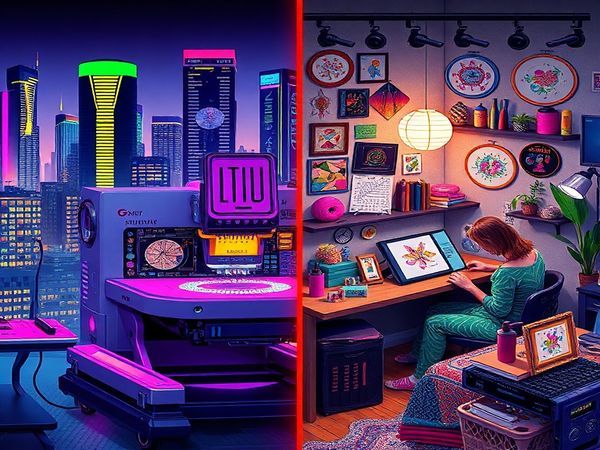
Futurists of the 1980s speculated about how computers could revolutionize embroidery. Inspired by big leaps in digital technology, they envisioned machines handling intricate designs faster and more accurately than human hands. This wasn’t just about speed; it was about a kind of perfection that could marry high-tech precision with the human touch of artistry. The thought was that embroidery could become automated, yet personalized, with machines crafting custom designs at the press of a button.
In the popular media, films and TV rarely focused on embroidery directly, but the underlying theme of technology enhancing traditional crafts was ever-present. This was a time when sci-fi stories often intertwined with domestic life, suggesting a future where even the quaintest household tasks became automated but were still personal and stylish, hinting at a world where embroidery might flourish anew as a symbol of personalization in an increasingly unified world.
For the ordinary person, talking about the future included dreams of easier, faster ways to infuse personal style into everyday life. The newfound accessibility of computers meant that designing something as complex as an embroidered tapestry might become as simple as typing on a keyboard. This idea wasn’t just exciting; it was liberating, as embroidery had long been a symbol of cultural identity and self-expression.
In professional circles, discussions centered around the allure of Computerized Numerical Control (CNC) machines, which suggested that the intricate process of stitching detailed patterns into fabric could eventually be mechanized without losing the artisan craftsmanship. Industry experts imagined new prospects for mass production of embroidered goods, potentially making high-quality design more available than ever before.
Embroidery Unraveled: The Reality of Today
Fast forward to today, and the story of embroidery is an intricate tapestry woven from both realistic advances and unforeseen twists. As you might expect, technology did indeed carve a niche in the world of embroidery. Computerized embroidery machines are now ubiquitous in both commercial and personal settings. These machines have radically changed how embroidery is created, capable of producing exact replicas of intricate designs with speed and precision that would fluster any 1980s futurist.
However, unlike the scenario painted by futurists, the explosion of machine embroidery did not erase traditional hand embroidery. Instead, both methods have carved out distinct places in the world of fabric and thread. Handmade embroidery continues to thrive as a hallmark of bespoke art, valued for its imperfections and personalized touch. It is celebrated in the burgeoning crafting movement, where people appreciate handmade goods as a counter to the mass-produced monotony encountered in many aspects of daily life.
Interestingly, the digital age did more than just automate techniques; it exploded creativity, allowing artists and hobbyists to share designs globally, transforming embroidery into a collaborative and international endeavor. Social networks and online platforms have opened previously unimaginable venues for sharing and selling handmade crafts, fueling communities of passionate embroiderers across the globe.
The reality saw embroidery evolving into both an ancient art and a forward-thinking discipline. Where the 1980s predictions hinted at a choice between tradition and technology, today’s world sees them intertwined. Machine embroidery has made the art more accessible to beginners, leading to a wider appreciation and participation in what was once a niche hobby.
Threads of Insight: Learning from the Past
Reflecting on the 1980s visions of embroidery and its actual evolution brings to light fascinating insights about human thought and creativity. One prominent lesson is that our predictions are often colored by the present. The futuristic visions were rooted not just in the technological leaps of the time, but also in the cultural shifts emphasizing both individuality and efficiency—a duality that continues to resonate today.
Embroidery’s journey also sheds light on the enduring value of personal expression, something machines can enhance but not replace. As much as technology has contributed, the art’s longevity resides in its ability to remain a quintessential form of human expression. People continue to cherish personal touches that machines can’t replicate, making handmade embroidery a prized possession even in a digital world.
This tale underscores how our visions of the future, be they optimistic or pragmatic, often appear in retrospect as a blend of accuracy and oversight. The empowerment from machinery and the connectivity from digital platforms coexists with a revived appreciation for tradition and the personal touch. Such a blend characterizes not just the future of embroidery but perhaps the future of craftsmanship at large.
Embroidery’s evolution from the 1980s to today is a testament to humanity’s ability to adapt and find balance between past and present. The stitched narratives of today have absorbed the excitement of the 1980s dreams, reflecting an evolved understanding where tradition and innovation are just two threads in the human tapestry.