From Instant Fluency to Duolingo: How 1970s Language Learning Fantasies Compare with Today’s Reality
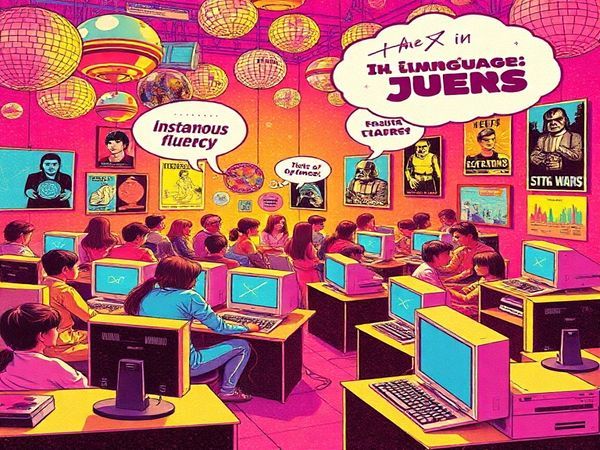
Imagine stepping back into the vibrant yet tumultuous 1970s. It was a decade of revolution and innovation, witnessed in everything from cultural movements to technological advancements. As disco balls spun and Star Wars debuted on the silver screen, conversations about the future buzzed with optimism. Among these many predictions was a speculation about language learning – a field ripe for transformation, buoyed by dreams of global communication and understanding amidst a Cold War backdrop. This era, armed with futuristic visions, saw the possibilities through both kaleidoscopic lenses of promise and practical challenges that seemed poised for dramatic change. But how did the future really unfold?
Visions of the Future: Language Learning in the 1970s
In the 1970s, the world seemed on the brink of a communicative revolution. As people imagined the future, language learning surfaced as a field poised for dramatic change. Consider the broader context: the United States and the Soviet Union were deep in an ideological standoff, yet the world was simultaneously becoming more interconnected, thanks to globalization and jet-age travel. This dichotomy fostered an acute awareness of the need to connect across borders, making language learning more essential than ever.
Futurists and educators of the time dreamt of a world where language learning would be instantaneous and intuitive, echoing the era’s love affair with sleek technology and modernism. Popular media often depicted people in glossy utopias easily chatting with anyone in the world, aided by sophisticated machines. Computers, which were just beginning to infiltrate mainstream consciousness, were imagined to become personal language tutors. This period saw the inception of dreams where learners were plugged into neural networks, much like a retro-futuristic Matrix, with computer chips translating thoughts into fluent speech in any language.
Beyond the speculative visions, there were practical discussions taking place in educational circles. Language theorists and teachers were beginning to tinker with methods that would speed up learning and retention – Total Physical Response and Suggestopedia being among the more experimental approaches. These sought to harness the power of immersion and suggestion to create better outcomes. The cultural zeitgeist enthused talk of language labs and audiovisual methods becoming widespread, making learning as much about sensory engagement as rote memorization.
For the everyday person, learning a new language might still have evoked images of dog-eared textbooks and foreign grammar drills. However, there was budding optimism that language education, like everything else around them, was on the cusp of a breakthrough. This was a time when hopes were as high as a disco dancer on the mirrored floor – and everyone wanted to be ready for wherever the future might take them.
The Reality of Language Learning: From Then to Now
Fast forward to today. As we currently stand, the future imagined in the 1970s is here, yet different than what was once portrayed. Computers indeed became ubiquitous tools in language learning, but not entirely in the envisaged role of instant fluency machines. Instead, the reality manifested as an eclectic mesh of digital resources, from apps like Duolingo and Babbel offering gamified lessons on smartphones to platforms facilitating live conversations with native speakers across the globe. These innovations are far cries from the envisioned brain chips, yet they are powerful in fostering connectivity and comprehension in diverse ways.
The modern techniques have leapt beyond the great expectations, leveraging artificial intelligence to offer personalized lessons and adaptive learning technologies. We’ve moved past language labs into virtual spaces where users can role-play real-life scenarios or practice pronunciation with chatbots. More than just transformative teaching methods, the internet has broken barriers, providing access to multilingual communities, cultural exchange, and collaborative learning environments. It’s a confluence of creativity that 1970s thinkers only dreamed of.
Despite these advancements, aspects of the envisioned future remain elusive. Real-time translation technology exists with tools like Google Translate, yet fluency still requires effort – an organic understanding that transcends mere words. Meanwhile, the way individuals learn remains varied, requiring motivation and engagement. The past’s notion of instant language acquisition, while not yet a reality, propelled an era of innovation that echoes into our language classrooms and laboratories today.
Insights from Expectations to Reality
Examining the expectations against today’s realities offers fascinating insights into human nature and our perpetual quest for interaction. The predictions of yesterday often reflected the spirit of their time – aspirational, leaning into the promises of burgeoning technology. In their enthusiasm to push the boundaries, they foresaw a world interconnected in ways they were only beginning to understand, driven by the cultural shifts toward openness despite geopolitical divides.
What stands out is how our expectations often mirror our immediate surroundings more than the future’s reality. The idealized, almost sci-fi aspirations for language learning in the 1970s spoke volumes about tech optimism and the hopes vested in connectivity as a binder of humanity. Yet, it was the incremental progress, fueled by human curiosity and persistence, that brought language learning to where it is today. Innovations were less about sweeping revolutions and more about cumulative breakthroughs. In this lies the lesson that transformation tends to be gradual rather than seismic, evolving through accumulated advancements.
The world’s retreat from machine-centric fluency visions toward human-centered learning also sheds light on our evolving thoughts about technology as a complement rather than a replacement for human ingenuity and interaction. Language, intrinsic to culture and identity, reveals itself not just as a tool for communication but as an element of shared human experience – a key that technology helps craft, not wholly create.
Our journey shows how the quest for language learning remains a reflection of broader desires – to connect, to blend comfort and challenge, and to expand our worldview. This ongoing evolution provides a lens through which we can consider future technological aspirations grounded in realism and humanistic values, shaping destinations imagined today into the surprises of tomorrow.
Through these revelations, we glean that while technology may rewrite landscapes, the enduring human spirit steers the course. And so, as we continue our explorations, we remain on an uncharted path fueled by the dreams of both yesteryears and the endless tomorrows ahead.