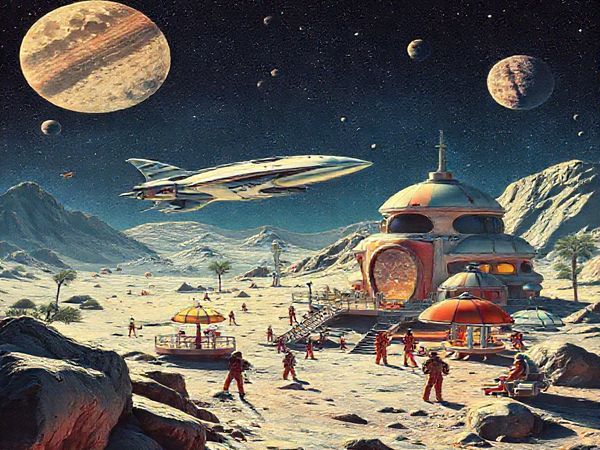
Moon Dreams of the 1960s: Bold Predictions, Real Triumphs, and Unexpected Lessons
The 1960s were a time of electric anticipation. The world was holding its breath as nations raced to achieve the unimaginable – sending a human to the moon. It was an era colored by skyward dreams and technological marvels, where the line between science fiction and reality sometimes blurred. As people looked toward the stars, what they imagined for the future of lunar flight was often shaped by influences that were as complex and varied as the era itself.
The Moon Through the Eyes of the 1960s
In the bustling years of the 1960s, the world was steeped in optimism. The space drive was not merely a scientific endeavor; it was a cultural phenomenon, fuelled by the rapidly advancing technology and a backdrop of geopolitical tension. The Cold War cast a long shadow, marking the race to the moon as a battleground for technological supremacy between the United States and the Soviet Union. This environment revved up public imagination, turning flight to the lunar surface into more than just a dream – it became a symbol of future possibility and national pride.
Futurists of the decade were often bold and imaginative, predicting a cascade of achievements that seemed boundless at the time. They envisioned outposts on the moon, commercial lunar flights, and a world where family vacations might see us gliding amongst the stars. This was not just the fantasy of educated elites or youthful dreamers but was seeded in mainstream media as well. Films and television shows like “Star Trek” and “The Jetsons” painted pictures of humans living and working in space, where lunar excursions were routine affairs, accessible and mundane. These depictions were laden with shiny spacecraft, characterized by designs that emphasized speed and sleekness – echoing the era’s love affair with aerodynamic aesthetics and futuristic flair.
In professional circles, discussions around the feasibility and methods of moon flight were grounded in the optimism of scientific advancements. Visionaries like Wernher von Braun spoke of lunar bases by the 1980s and massive space stations circling our pale orb. These ideas trickled down into the consciousness of the common folk, who marveled at the pace of progress with a blend of awe and anticipation. It wasn’t just a matter of if, but when humans would stand on moon rock, and what would come next.
Everyday conversations were peppered with this moonlit future. Children in classrooms watched avidly as they were taught that they might become astronauts, while adults gathered around televisions, rooting for Apollo missions with an enthusiasm usually reserved for their favorite sports teams. Newspapers and magazines were littered with illustrations depicting futuristic cities on the moon, complete with domed habitats and buzzing lunar vehicles.
The 1960s mindset was one suspended between fear of global conflict and the thrilling sense that humanity was on the precipice of a new era. This dynamic tension played a central role in how people imagined flight to the moon and beyond, with the latter representing a hopeful frontier amidst earthly concerns.
A Journey Beyond Dreams
When Neil Armstrong set foot on the moon on July 20, 1969, it marked a triumph of human ingenuity and spirit. Yet, the path of lunar exploration that followed was not the seamless continuation many had expected. The haze of dreamlike projections cleared to reveal a reality that diverged in fascinating ways from the spirited forecasts of the past.
The immediate aftermath of the Apollo missions saw a slowdown in lunar exploration, contrary to the ambitious visions of permanent bases or frequent flights. Since Apollo 17 in 1972, no human has returned to the moon – a far cry from the bustling interplanetary traffic imagined by mid-century dreamers. The reasons for this shift were multifaceted; budget constraints, shifting political priorities, and the evolving nature of space exploration all played roles in redirecting the trajectory charted by early space visionaries.
Today’s moon missions focus on sustainability and international cooperation, with a rekindled interest driven by plans from NASA’s Artemis program and private entities like SpaceX. We are witnessing a revival of lunar ambitions, albeit in a form molded by decades of technological evolution and global collaboration rather than competition. This differs from the earlier space race’s bilateral paradigm, signifying changes in both ambition and philosophy.
While we don’t have moon colonies or weekly shuttle services to this day, technology has advanced in ways the 1960s futurists couldn’t fully grasp. Satellites orbit the moon to gather data, and robotic missions serve as the forefront of lunar exploration, revealing nuances of the lunar surface unseen by human eyes. The invention of new materials, miniaturization of electronics, and advanced communication technologies have enhanced our capacity, laying the groundwork for eventual human return to the moon and possibly beyond.
In a surprising alignment, the spirit of cooperation and commitment to shared goals dominating current lunar exploration initiatives reflects sentiments from the 1960s about what humanity can achieve when it allies for a common purpose. Yet the pace and nature of progress remind us that human foresight is exceptionally potent yet intrinsically imperfect.
Lessons from Lunar Aspirations
Examining the gap between 1960s expectations and the present reveals profound insights about imagination’s dance with reality. The futuristic visions of astronauts hopping from lunar shuttles onto bustling space ports illustrate how human predictions often mirror current desires, beliefs, and sociopolitical climates more than the ensuing future’s pace and nature.
Such dreams informed by the 1960s were uniquely colored by the exuberance and fears of their times. They highlight how hopes for advancement were often tied to visions of immediate peace and prosperity, suggesting that the yearning to explore space is an expression of our deeper search for meaning and unity in a rapidly changing world.
As humanity stands on the cusp of a new era in lunar exploration, realizing dreams written in a different century, we must remember the lessons of patience and resilience. The moon’s allure persists, reminding us that our ultimate trajectory in space isn’t confined to the materials that carry us there but is also shaped by our evolving intent and purpose. In essence, the moon is as much a mirror reflecting our ambitions as it is a destination.
In looking back, perhaps the most remarkable revelation is how early imaginings, though occasionally outlandish, embody an essential truth about our species: that inherent drive to explore, to strive, and to dream, persists across ages, a constant beacon drawing us ever outward.