Composers of Tomorrow: 1950s Visions vs. Today’s Reality – A Symphony of Unexpected Turns
There’s a certain magic to peering through the lens of the past, where hopes and fears mingle into a rich tapestry of human imagination. The world of the 1950s was a curious one, poised on the cusp of massive technological change, yet still tethered to age-old traditions. In this dynamic era, people were asking – what would the future hold for the timeless figure of the composer?
The Composer’s Future: 1950s Visions and Dreams
In the vibrant post-war era of the 1950s, a sense of buoyant optimism marked the cultural landscape. The world had emerged from the shadow of two devastating wars, stepping tentatively but hopefully into a new dawn. Amidst this backdrop, futurists and the average person alike pondered what might become of the venerable role of composer in the years ahead.
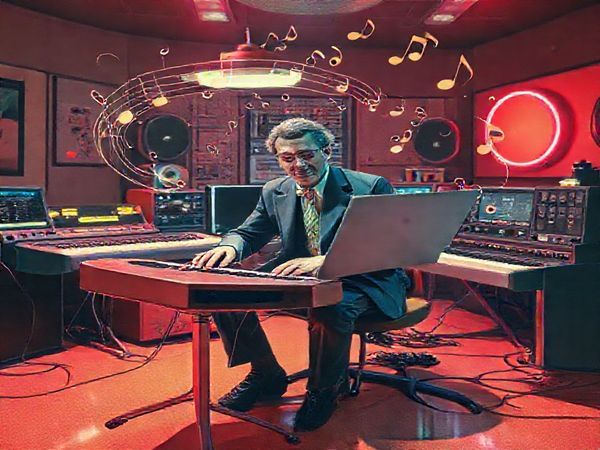
Popular media painted a picture brimming with electrifying potential. Films and radio, which dominated the entertainment space, hinted at a future where music was intertwined with ever-advancing technologies. Some visualized composers wielding cutting-edge electronic instruments, crafting sounds previously unconceived – a mix between mad scientists and visionary artists. This was an era where the theremin had started to haunt cinema soundtracks, and the possibility of fully electronic orchestras seemed tantalizingly within reach.
In professional circles, discussions about the future of composition were imbued with both excitement and trepidation. While some heralded the electronic innovations as harbingers of a new musical renaissance, others feared a loss of the human touch. A mechanized world might diminish the composer’s role, reducing them to operators of an audio assembly line rather than creators in the romantic tradition.
Ordinary people, meanwhile, were experiencing music in a way that felt both modern and intimately personal. The phonograph, already a household staple, allowed compositions to slip into daily life seamlessly, setting the mood for everything from family dinners to quiet evenings by the fire. People fantasized about composers whose work would become permanently embedded in the sonic background of everyday life, perhaps even anticipating home devices playing personalized symphonies on demand.
Socially, the mid-20th century was marked by a burgeoning youth culture, complete with its youthful rebellion and fresh artistic expressions. Jazz and, soon, rock ‘n’ roll were redefining the musical landscape, suggesting a future where classical composers might either merge with these new influences or risk obsolescence. Particularly vivid in the American consciousness was an image of the composer who could blend Bach with bebop, embodying the balance between tradition and innovation, reflecting society’s quest for identity in a rapidly changing world.
From Reality to Now: Actual Evolution of the Composer’s Role
Flash forward through the decades, and the future unfolded in directions both anticipated and unforeseen. The role of the composer has indeed morphed substantially since those speculative musings of the 1950s.
The advent of digital technology and the internet has revolutionized music creation. Electronic music, once the plaything of niche circles, exploded into the mainstream, fulfilling the 1950s vision of innovation-driven composition. Artists today not only use electronic instruments but have entire symphonies at their fingertips in digital form, rendering grand, imagined possibilities into everyday realities.
Yet, rather than replacing the traditional composer, technology has become an extension of their creative arsenal. Composers craft scores for films, video games, and immersive online experiences, often blending digital techniques with live performance. Professional dialogue has shifted from a frontier fraught with anxiety about mechanization to one of boundless creative opportunity.
Surprisingly, even amidst tech-centric innovations, the romantic ideal of the composer as a solitary genius has endured. Composers still enjoy esteemed positions in society, perhaps more varied today but no less significant. They are the stars of soundtracks that define film franchises, the architects of sonorous video game landscapes, masters of operas both classical and contemporary.
Socially, as predicted, music has become more deeply woven into the fabric of daily life than the 1950s could have dreamed. Streaming platforms personalize playlists that echo through every corner of individualized spaces, realizing the dream of composer-crafted soundtracks to daily existence. The novelty of home devices coaching a reaching reality, though little did the 1950s foresee AI-generated compositions resonating warmly or artificially through speakers today.
Surprisingly, classical music remains fervently alive – reimagined but cherished – with young musicians and composers infusing it with diverse, global influences. The promise of jazz-infused classical creations continues, albeit in forms never quite foreseen in mid-20th-century imaginings, carved out by composers aware of a rich tapestry of musical heritage they adamantly preserve and innovate.
Learnings from the Crossroads of Expectation and Reality
The fascinating comparison of 1950s dreams with today’s reality reveals not only the missteps of foresight but also inherent human traits in future prediction. Our anticipation of technological impact often teeters into exaggerated sci-fi fantasies, yet the core human elements remain firmly rooted – creativity, emotion, the quest for meaning.
What becomes apparent is that our visions of the future frequently mirror the aspirations and anxieties of the present. The 1950s, with its mingling of optimism and dawning Cold War unease, reflected a desire for progress arriving hand in hand with harmony and peace, the composer serving as a symbol of that balance.
This retrospective shows us how the composer’s role has thrived in adaptability – always reshaping with cultural and technological waves. Yet, it also stands as a testament to human resilience and continuity. The fundamental purpose of music composition, to stir hearts and challenge minds, persists regardless of the tools at hand or the pressing concerns of any particular era.
In considering the future, perhaps the most powerful insight is that the composer will continue to embody the spirit of their time; ever changing, ever relevant. Just as the predictions of the 1950s seem quaint but endearing today, future innovations will inevitably surprise, delight, and perhaps bemuse us, driven by the same passions and timeless human longing for connection that have motivated composers since time immemorial.