From Free Love to Digital Romance: 1970s Future Predictions vs. Today’s Reality
Stepping into the time machine that is the 1970s, we find ourselves amid a whirl of social revolution and unabashed excitement for a future that promised unprecedented freedom and transformation. As if pulled by invisible strings of anticipation, people from various walks of life leaned forward into a future that seemed to promise not just flying cars and hoverboards, but a distinctly more liberated and exploratory landscape of sexuality. The imagination of the era was shaped by a complex web of cultural shifts, technological advancements, and social experimentation, all mingling to create a unique vision of what intimacy and desire might become in the years ahead.
1970s: An Odyssey of Sexual Expectations
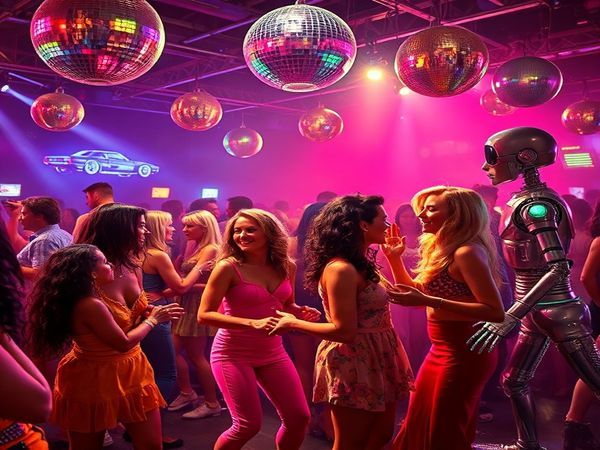
Under the hazy glow of disco lights and the emancipating ethos of “free love,” the 1970s were a decade brimming with optimism about the boundaries that could be shattered or, more enticingly, altogether ignored. The sexual revolution of the 1960s had laid the groundwork for deeper exploration and less inhibited conversations about intimacy and identity. Within this climate, futurists and everyday dreamers alike envisioned a future unbound by the mores of yesterday.
Futurists and cultural speculators of the time envisaged a world where technology would further liberate human relationships. Artificial intelligence and robotics, with their boundless potential, were often imagined as evolving to become partners in both the intellectual and sensual realms. One daring conjecture was the idea of sex robots that could cater not only to physical needs but also provide companionship, symbolizing the ultimate convergence of technology and human emotion.
Cinema and literature gave life to these predictions. Stanley Kubrick’s visionary work, “A Clockwork Orange,” introduced audiences to bizarre notions of mind control and behavioral engineering, hinting at a dystopian future where sexuality could be manipulated by external forces. Meanwhile, the playful, utopian essence of science fiction cinema imagined worlds of tantalizing freedoms – think “Barbarella” and its portrayal of futuristic sexual liberation.
In everyday conversations and social gatherings, discussions about sexuality were becoming more candid and common. The mainstreaming of conversations about sexual orientation, gender identity, and the rejection of monogamy were beginning to take hold, hinting at changes that were yet to come.
On the professional front, discussions were burgeoning in psychology and sociology about a future of sexuality that was fluid, based more on choice and individual preference than on reproductive imperatives or historical norms. Books like “The Joy of Sex” made sex education not only an informative tool but also an exploration of the human experience. This period was marked by an anticipation of endless possibilities, colored by both idealism and a touch of hedonism as people pondered what newfound liberties might bring.
The Reality Emerges: Unfolding the Future of Sex
As the decades rolled on, the future of sex did not entirely follow the trajectory imagined through the rose-tinted glasses of the 1970s. The evolution of sex was far from the linear path of progressive freedom and technological transformation that some had predicted. Instead, it unfurled in unpredictable patterns, weaving through socio-cultural changes, technological progress, and varied waves of conservatism.
Technology did give rise to new forms of connection and sexual expression, albeit not quite as envisioned. The internet became a cultural cornerstone, revolutionizing the way people connect in ways no one could predict. Online dating transformed courtship rituals, while video chat technologies brought a new dimension to long-distance relationships. Virtual reality and teledildonics introduced novel forms of intimate interaction, yet true-to-life sex robots remain more speculative than reality.
Moreover, the sexual liberation movement took steps forward in the recognition of diverse identities, with movements advocating for LGBTQ+ rights gaining remarkable ground. Yet, these advancements were counterpointed by a recurring clash with conservatism, demonstrating that the journey toward freedom is neither straightforward nor unchallenged.
In comparing the imaginings of the 1970s with the reality of today, we find an intricate narrative of divergence and convergence. Certain aspects, like the normalization of more open discussions on sexuality and the acceptance of varied relationships and identities, resonate with the hopes of that audacious era. On the other hand, technology’s true evolution, marked by social media’s grip on human interaction instead of human-like companionship from robots, showcases both the limits and unexpected paths of innovation.
Lessons from the Intersection of Dreams and Reality
The discrepancies and occasional alignments between the 1970s vision and the current landscape offer us profound insights into human foresight. Most notably, our visions of the future often reflect the present more than they predict the unknown. The optimism around technology as a catalyst for sexual liberation was rooted in the technological advances of that time, embodying a belief in technology as a tool for social progress.
This exploration reveals the dynamic nature of human sexuality and how powerfully it is shaped by cultural context. While certain technological innovations materialized, the shift in societal norms and the slow journey towards acceptance of sexual diversity have equally influenced the landscape, reinforcing that sexuality is as much about emotion and identity as it is about science and technology.
Moreover, examining these past predictions uncovers a persistent truth: the human need for connection and understanding remains constant, regardless of the era or its technological achievements. The 1970s hope for a technologically entwined yet liberated future of sex was really a reflection of a deeper yearning for understanding and acceptance.
In this reflection, we find that the narrative of sex and the future is not solely one of technological evolution, but a tapestry interwoven with human resilience, societal shifts, and an ever-present quest for greater connection and meaning. It’s these insights that remind us to view both the past and the future not only as destinations but as ongoing journeys shaped by who we are today.