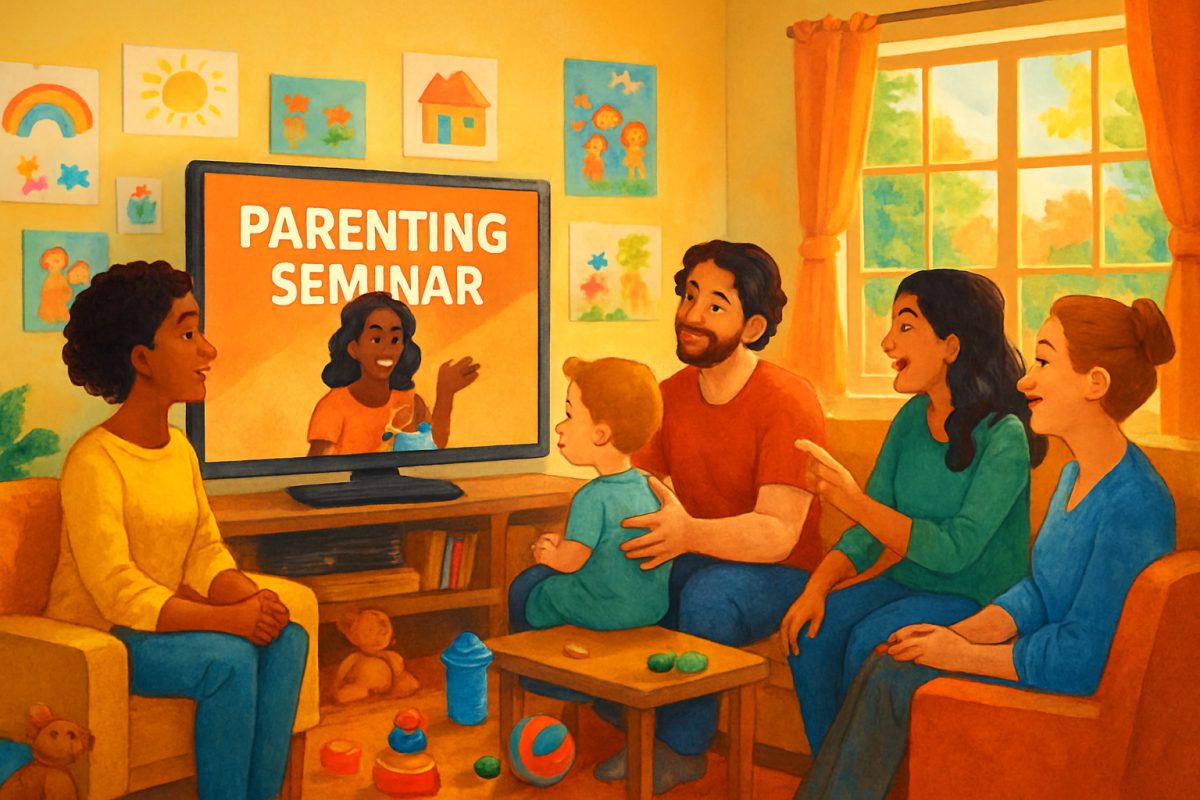
Online Parenting Seminars Show Promise in Boosting Children’s Mental Health and Wellbeing
The Quest for Better Parenting: An Unyielding Journey
The way parents raise their children often mirrors the whispers of ancient wisdom passed down through countless generations. Yet, in today’s ever-accelerating world, these whispers meet the unyielding roar of scientific inquiry; always asking, always probing, and forever evolving. Among the clamor to help children thrive, a team led by researchers Boyle, Sanders, and colleagues embarked on a study that pulls at the very roots of parenting practices as they relate to childhood mental health. Their study, published in the Journal of Child Psychology and Psychiatry, delved into the effectiveness of low-intensity, school-based online parenting seminars and gauged the ripples they create in children’s wellbeing.
Beyond Traditional Boundaries: A Modern Approach to Parenting Support
The question the researchers sought to answer seems deceptively simple: Could brief online parenting seminars forge better outcomes in children’s social, emotional, and behavioral realms? But why pursue this now? The answer lies in the collision of exceptional circumstances and growing societal demands. Increasingly, parents are searching for practical, accessible, and flexible resources that acknowledge the unique pressures they face today. Add to this the transformative potential of digital platforms, and you have fertile ground for innovation in parental education.
The study’s backbone was a cutting-edge design, known as an incomplete batched stepped wedge cluster randomized trial. Simply put, this methodology allowed the inclusion of parents across varied circumstances in three states in Australia. The digital seminars reached nearly a thousand parents of school-aged children. This structure intertwined with real-world school settings enabled practical integration of parenting developments within the community fabric, thus presenting groundbreaking opportunities for scalability and adaptation.
Unveiling the Impact: A New Lens on Children’s Wellbeing
Peering through the analytical lens, the researchers unearthed promising evidence. Across numerous metrics, significant improvements surfaced in both parents and children. Among the noteworthy shifts – a climb in positive parenting methods and a decline in coercive techniques. Parents also experienced better adjustment and self-regulation, which trickled down to reductions in child anxiety, behavioral issues, and emotional maladjustment. This trend marked an advancement, not just reminiscent of textbook knowledge, but vivified in the lived experiences of everyday families.
While these developments shine with promise, not all areas showed change. Measures of child depression and parental relationships did not experience notable improvement, painting a more nuanced picture of the complexities involved. These findings remind us that the multifaceted tapestry of human experience cannot be readily distilled into binary outcomes. Yet, the positive changes observed suggest a new avenue to explore in bolstering familial dynamics and child development.
Reimagining Education’s Role in Mental Healthcare
This study ventures into a fascinating dialogue about the intersection of education, parenting, and public health. Schools, long seen as crucibles of academic learning, are increasingly positioned as pivotal points for broader community wellness initiatives. The research taps into this potential, illustrating schools’ capabilities in housing vital resources that extend beyond simple academics.
Intriguingly, this aligns with emerging global trends where education systems adopt comprehensive approaches to nurture well-rounded individuals. More than just vessels of knowledge, these institutions become community hubs where educators, parents, and healthcare professionals intersect and collaborate. It underscores the significance of leveraging existing structures to extend the reach of mental health and wellbeing initiatives effectively.
Growing Questions and Unforeseen Possibilities
Yet with each answer, new inquiries sprout. Can online seminars truly replace the grounding experience of face-to-face interactions? Given the advancement of telehealth and digital platforms, what other domains might benefit from a similar approach? Furthermore, how do we address the nuances of individual family dynamics in such universal programs? As a seasoned observer of scientific developments, I see these questions as a bridge – linking what has been uncovered with the vast possibilities that await in the horizon. Each discovery, each insight, nudges us closer to understanding the intricate dance of parenting and child development. This particular study offers more than glimpses into what could be. It issues a call to imagine and mold future avenues where harmonious family roles and children’s flourishing become the ordinary outcome, rather than the aspirational dream.
Reference:
Boyle, C., Sanders, M. R., Ma, T., Hodges, J., Allen, K. A., Cobham, V. E., … & Warton, W. (2025). Can a low‐intensity evidence‐based parenting seminar series promote the mental health and wellbeing of children and families? A cluster randomised trial. Journal of Child Psychology and Psychiatry.