From Crystal Balls to Clicks: How 1930s Ad Dreams Stack Up Against Today’s Reality
In the dim glow of the 1930s, amidst the shadows of the Great Depression, a world still brimming with hope and imagination dared to glance towards the future. A time when radio was king, Hollywood’s golden age was in full swing, and newspapers dominated information distribution, the decade flirted with visions of progress and prosperity beyond the shadow of economic gloom. People across the globe were spinning visions of what advertising might become, fueled by the heady advances of technology and a deep-seated optimism that better days were just around the corner.
The 1930s Vision – Advertising in Technicolor Dreams
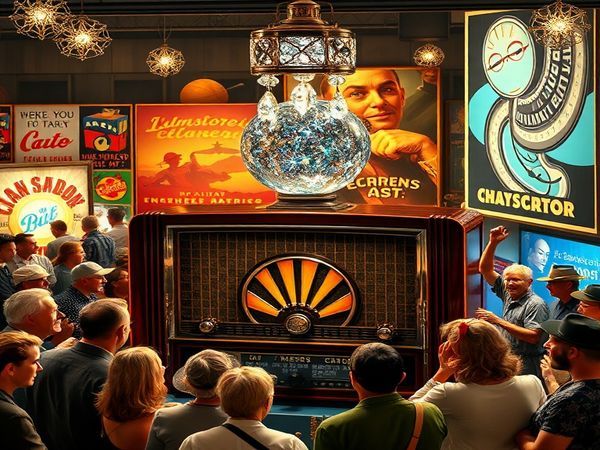
In this era of emerging modernity, advertising was as much a reflection of societal aspirations as it was a tool of commerce. Enthralled by technological progress, people in the 1930s envisioned advertising as an art form evolving in tandem with inventions. The world was buzzing with the possibilities unleashed by radio waves reaching far into the night, promising that even the most remote homestead could hear orchestras from the grandest concert halls. Futurists and visionaries of the era imagined that radio would become more interactive, like a kind of communal living room where everyone was invited.
Popular media fed into these dreams with extravagance, portraying futuristic cities in films and Art Deco posters that gleamed with metallic vitality. Movies like “Metropolis” and magazines like “Popular Mechanics” painted pictures of machines that talked – not unlike the charming radio pitches of the time – enchanted by the tantalizing prospect of a distant future where advertisements could speak directly to each consumer in their home. It was a blend of fanciful thinking and emerging reality, where tangible advances in communication technology inspired townsfolk to see a more personal, tailored kind of advertising as imminent.
Ordinary individuals, seated around their radios or flipping through the Sunday newspaper, were reimagining the future of ads with every jingle and fetching illustration. Advertisements themselves took on a life of their own, with grandiose claims and bold promises that were emblematic of the age’s daring and optimism. These campaigns were designed not just to sell, but to inspire hope – a critical function given the recent memory of bread lines and dust bowls.
This optimistic outlook on advertising also reflected a longing for connection during a time when communal bonds were strained by economic hardship. Many believed that businesses could reforge societal links through these messages, rooting them in shared visions of prosperity and modern comfort. The cultural heart of the 1930s beat with a belief that advertising, by harnessing new technologies, would facilitate a shared journey toward better futures.
The Evolution – Reality Unfurls
As we journey from the 1930s to today, the story of advertising unfurls in unexpected ways. When television emerged in the mid-20th century, it did fulfill some of the forecasts grounded in the stunning power of visual media, producing ads that spoke directly to families – often during much-loved sitcoms – thus weaving into daily life in a way radio had dreamed to achieve. TV commercials rapidly became the arena for elegance, humor, and persuasive artistry, shaping public perception at a scale unimaginable to earlier generations.
Fast forward to the digital age, and the landscape is transformed once more in ways that might be dizzying to our 1930s dreamers. The internet has revolutionized advertising from its traditional forms, propelling it into a sphere scarcely conceivable amid the radio-static air of the Depression. Digital marketing today involves analytics that predict customer preferences with astounding accuracy, and online ads are hyper-targeted innovations with algorithms — far beyond the interactive futurist parlance of yesteryears.
Yet, intriguingly, those daring expectations of personal, tailored advertising have come true, albeit in unimagined digital formats. Virtual and augmented reality ads, where one can literally walk through an advertisement, resonate with that early vision of immersive experience. However, the privacy concerns accompanying this targeted advertising reveal an unpredicted complexity absent in the hopeful visions of the 1930s.
While the means and media have evolved, the fundamental emotional motives of advertising remain unchanged. Even today, savvy campaigns tap into the very spirit of hope, play on fears, and inspire communal connections – the same psychological chords advertisers have always strummed, albeit with tools exponentially more advanced.
The Wisdom of Hindsight
Reflecting on this tale of expectation versus reality unveils a lesson in human projection and the cyclic nature of hope as a driver of innovation. Our expectations about the future, like those of the 1930s, are not simply predictions built from new technologies but are deeply rooted in the cultural and emotional zeitgeist.
The 1930s visionaries were not wrong in their broad strokes – that advertising would become ever more integrated into our lives and technologies, and that it would address consumers in new, intimate ways. What they couldn’t foresee was the particular path technology would take, or the complex socio-political landscape into which it would fit.
Today’s advertising reflects a world no longer united solely by shared experiences, but also fractured by the individualism made possible by personalized media. The tension between the collective dreams of the past and the fragmented reality of the present evokes a nostalgia for a unified vision – a feeling that advertising continues to tap into, consciously or not.
Moreover, this contrast highlights a profound truth about progress: while the tools and platforms of yesterday’s dreams evolve, the core desires that shape them remain timeless. Despite technological advances that mold the what and the how, the why – those human motives underneath – echo perpetually. The timeless relationship between aspirational advertising and human emotion suggests its enduring role as not just a commercial vehicle, but as a cultural dialogue.
In the end, the ongoing conversation between past expectations and present reality weaves a rich tapestry revealing how advertising evolves. It serves as a lens through which we understand our perpetual yearning for connection, our constant flirtation with the new, and our enduring hope for a brighter future.