The Great Leap Forward? Unpacking 1960s Dreams and Today’s Realities of China’s Economic Evolution
In the 1960s, as the world teetered on the cusp of extraordinary change, visions of the future were often imbued with both hope and uncertainty. Nowhere was this more palpable than in the reflections on China’s economic potential. As new eras unfolded globally and technological marvels like the space race captivated imaginations, many pondered what lay ahead for China, a nation with a complex past and an indomitable spirit on the brink of transformation.
The 1960s: Dreams of China’s Economic Potential
In the early 1960s, the cloud of history lingered heavily over China. The Great Leap Forward had ended in disaster a few years prior, leaving economic and social scars. Yet, amidst the struggles, there was a renewable sense of ambition for a better future. This was an age when futurists across the world sketched out visions of tomorrow with excitement, fueled by the belief that human ingenuity knew no bounds. From bustling coffee shops in Europe to progressive think-tanks in North America, dialogues about China’s future were abundant, vivid, and ambitious.
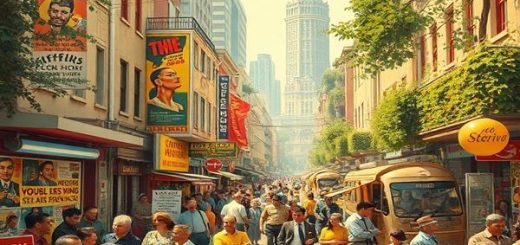
Futurists envisioned a China that would rapidly industrialize, riding the wave of modernization. The belief was that China, with its vast population and rich cultural legacy, would eventually find its footing and emerge as a formidable force in the global economy. Influenced by the emerging conception of development, it was assumed that China would follow a path similar to the West, marked by heavy industry, mechanization, and urbanization. Newspapers and magazines depicted images of futuristic Chinese megacities brimming with factories and skyscrapers—a world where traditional Communist ideals met the wonders of modern machinery.
For many ordinary people, discussions about China’s economic future carried an air of mystery and exoticism. With less access to global communication than today’s society, China’s trajectory was often perceived through a lens of speculation. This mystique was sometimes echoed in the era’s films and literature, which portrayed diverse futures ranging from a technologically wondrous landscape to more dystopian scenarios where political ideologies clashed with economic ambitions.
Professional circles, such as economists and policy makers, viewed China’s economic journey through a prism of skepticism mixed with cautious optimism. The successes of other Asian economies provided a blueprint for what might be possible. Yet, they were aware of the immense challenges posed by political upheaval and internal disruptions. While the West enjoyed an unprecedented era of consumer capitalism, China seemed poised for a more tumultuous path, unpredictable yet ripe with potential.
The Reality of China’s Economic Rise
Fast forward several decades, and the actual trajectory of China’s economy unfolded in a way that not even the boldest predictions could entirely foresee. The transformation has been nothing short of dramatic, unfolding in phases that spanned from isolation to integration in the global economy. The reform era initiated by Deng Xiaoping in the late 1970s marked a pivotal shift that steered China towards market liberalization and economic openness.
China embarked on a journey of accelerated industrialization, urbanization, and globalization, burgeoning into the world’s second-largest economy by nominal GDP. Major cities like Beijing and Shanghai grew into sprawling megacities, emblematic of China’s rapid modernization. Key developments such as joining the World Trade Organization in 2001 and the advent of high-speed rail epitomized China’s role as a crucial node in global economic networks.
However, this progression was far from linear. The Chinese economy had to navigate the challenges of demographic shifts, environmental concerns, and political tensions, balancing growth with sustainability. While many predictions about glittering Chinese skylines came to fruition, the path was paved with unexpected complexities. The dependency on exports gave way to a focus on domestic consumption and innovation in fields like technology and green energy, showcasing a willingness to adapt and redefine economic strategies.
Interestingly, some elements forecasted in the 1960s turned out to be more prescient than initially appreciated. The idea of China becoming a manufacturing powerhouse became reality, although the nuances of how this unfolded surprised many. The level of integration within global supply chains and the pace at which technological innovation was adopted exceeded many expectations from the past.
Lessons from the Vision vs. Reality
Looking back, the disparity and alignment between past expectations and present reality offer fascinating insights into the complex process of envisioning the future. The 1960s imagination of China’s economic ascent reflects a broader human tendency to project contemporary values and technological paradigms into imagined futures. Futurists of that time, habituated to the industrial growth models of the West, envisioned China following a somewhat similar path, perhaps overlooking the unique socioeconomic and political fabric of the nation.
This comparison uncovers an important lesson in futurism: predicting the future often says as much about the present as it does about what is to come. The 1960s were marked by a sweeping technological optimism that saw industrial progress as the universal roadmap to prosperity. Yet, China’s trajectory reminds us that different cultural contexts can give rise to divergent forms of progress, which do not always align with prevailing global narratives.
Understanding this narrative highlights the dynamic nature of China’s economy. Its evolution underscores the importance of adaptability and resilience, as China has continuously redefined itself in response to changing global landscapes. It also expounds on the broader theme that economic growth is intertwined with cultural, political, and environmental factors that can steer development in unexpected directions.
As we contemplate the future today, these reflections serve as a reminder of the need to embrace diversity in our thinking and remain open to possibilities beyond existing paradigms. The story of China’s economic journey is a testament to the power of vision and determination, illustrating that the future is not a mere extension of the present but a landscape capable of defying the limits of our imagination.
In the vast canvas of history, the evolution of China’s economy stands as an extraordinary tale of transformation. It invites us to ponder the wonder of human potential and the inexhaustible capacity for reinvention that resides within society.