From Hovering Hymns to Digital Devotions: 1970s Predictions for the Future of Prayer and Today’s Reality
As the 1970s unfolded, the world was a kaleidoscope of change. People’s imaginations danced with ideas of what was yet to come, a symphony of possibilities shaped by a blend of cultural evolution, technological innovation, and social transformation. Among these reflections of a future still uncharted was the intriguing notion of prayer – a timeless act intrinsically tied to human hope, searching, and connection. The forecasts of how prayer might evolve were not only a vision of spirituality but also a mirror into the hopes and anxieties of the era.
Envisioning Prayer in the Age of Cultural Awakening
The 1970s were imbued with a sense of boundary-pushing exploration, a quest fueled by both technological advances and a profound cultural shift. It was a time of space races and environmental awareness, where tradition collided headlong with the rebellion of new ideas. Amidst this dynamic backdrop, the future of prayer was imagined by many through the lens of transformative potential.
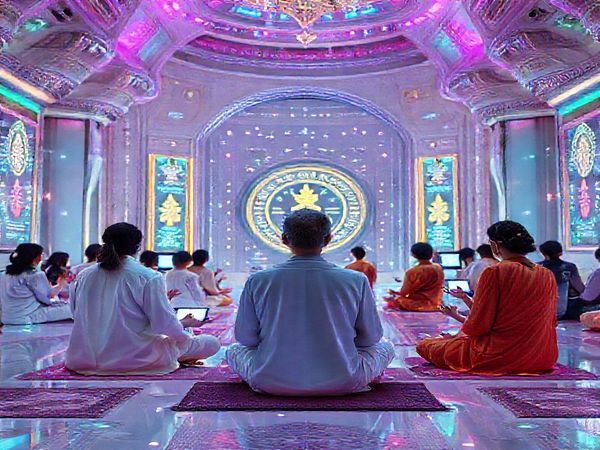
Futurists of the era, speculative thinkers who captivated audiences with their forecasts, often depicted a future where prayer transcended traditional confines. They envisioned technologies that could amplify spiritual experiences, projecting that one day people might employ electronic aids to enhance meditation practices. The notion of a “prayer machine” – perhaps a device that could induce feelings of peace or connect one with a collective consciousness – was not dismissed as mere fantasy but discussed in earnest in symposiums and think tanks.
In popular media, an air of mystique surrounded the concept of future prayer. Movies and television sometimes portrayed prayer in futuristic settings, where humans and artificial intelligences might mutually understand or even participate in spiritual experiences. Films depicted polished chrome temples where automated systems recited ancient mantras, emphasizing unity between modernity and tradition – a visual metaphor for humanity’s hope to harmonize with change.
Amid this eclectic anticipation, everyday conversations reflected a softer yet equally significant transformation. Social movements advocating for peace and love revitalized interest in spirituality, prayer included, as people sought deeper meaning in uncertain times. While technology loomed large in these imaginings, many ordinary individuals expressed hope that prayer’s future would maintain space for personal, silent reflection. It was not uncommon for professional discussions and everyday kitchen table talk to converge on questions of what role prayer should play in a world increasingly defined by its technological prowess.
Across cultures, references to Eastern philosophies took hold, reimagining prayer as a meditative practice that transcended both faith and formality. The 1970s were years of exploration beyond the boundaries of conventional religion, with globalization enabling exposure to diverse spiritual practices. Conversations at yoga studios or university cafes probed whether prayer would become an inclusive, universal language as global connections strengthened.
Thus, the era depicted a tomorrow where prayer was both a personal ritual and a universal experience, one grounded in an ever-evolving landscape, acknowledging our innate quest for something larger than ourselves.
The Reality of Prayer’s Unfolding Story
Today, as we flick through the pages of history, we find that reality has crafted a nuanced tale for prayer, both resonant with and divergent from the visions of the 1970s. While some forecasts have aligned astoundingly with modern practices, others illustrate how unpredictable the path of progress can be.
The prediction of technology enhancing spiritual practices has indeed come to pass, but not always in expected ways. While no “prayer machines” exist in the manner once imagined, digital prayer apps and wearable mindfulness devices have become commonplace. These tools offer guided meditations, prayers for different occasions, and even virtual communities where individuals around the world can unite in spiritual reflection. Instead of automated mantras in chrome temples, people lean on personalized digital experiences, often curated with artfully designed interfaces.
Interestingly, while technology has modified how prayer is practiced, it hasn’t supplanted the fundamental need for connection found in traditional methods. If anything, it has provided additional pathways for exploring spirituality rather than replacing older ones. Online services allow for communal prayer even when individuals are geographically separated, exemplifying the blend of ancient intention and modern execution.
In practice, the globalization of the human experience has facilitated a rich tapestry of spiritual blending. Purported by the hippie circles and the followers of spiritual leaders in the 1970s, the interest in Eastern philosophies continued to flourish and integratively enrich Western spiritual practices. Yoga has found its way into church basements and community centers, and mindfulness meditation is integrated into healthcare as well as schools.
The cinematic visions of human-AI prayer connections remain largely unexplored in reality, yet the way digital tools have facilitated emotional support networks hints at how the boundaries between humanity and technology continue to evolve. Though not sentient, today’s artificial intelligence offers companionship, guiding individuals through spiritual journies, much like a high-tech butler steeped in spiritual wisdom.
The continuity of prayer’s personal impact also endures. Just as foreseen in casual 1970s conversations, prayer remains a potent personal ritual as people continue to find solace and connection in traditional practices. The flame of the human spirit recognized by past generations continues to illuminate our present.
Lessons From The Past And Beyond
Reflecting on the gap between expectation and reality, we uncover insights into the human spirit’s adaptability and tenacity. The 1970s were a time when people gazed at the future with awe and trepidation, and the imaginings of prayer’s transformation are as much a time capsule of that era as they are a prophecy of innovation.
The future’s predictions often reflect the assumptions and aspirations of the present. Technology once thought of as futuristic has interwoven with daily life in ways more nuanced and personalized than initially imagined. This stands as a testament to how technology serves as an enabler, not a replacement, for old practices that fulfill intrinsic human needs.
Our faith in technological advancement often expresses both hope for enhancement and fears of alienation. Examining the past’s visions of prayer reveals our deep longing for interconnectedness – with each other, with higher powers, and with the universe around us. It’s a reminder that no matter how technology changes, our search for meaning tends to remain rooted in connection and understanding.
In essence, the evolution of prayer paints a picture of perennial human values – not of a linear path but a mosaic, rich with cultural influences, shaped by the interplay of tradition and innovation. As we peer into the possibilities ahead, the tapestry of the human spirit remains resilient, urging us to imagine futures with compassion, integration, and inspiration – lessons gleaned as much from what was anticipated as what unfolded.