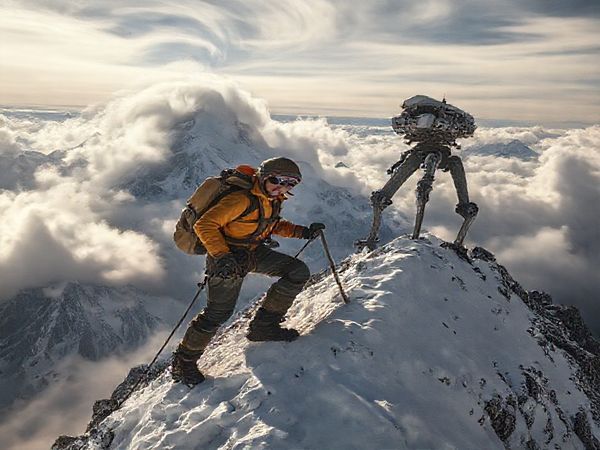
Scaling New Heights: 1940s Futurists vs. Today’s Mountain Climbing Realities
In the midst of swirling clouds of uncertainty and change brought on by the close of a world war, the 1940s was a decade alive with imagination and ambition. As nations rebuilt and individuals yearned for new adventures, the human spirit sought inspiration not only in the reconstruction of cities and societies but also in the conquest of the natural world’s most formidable peaks. Mountain climbing captivated the imagination as an emblem of personal triumph and exploration, offering a glimpse into what the future might hold for those daring enough to scale the heights.
Scaling Heights in the 1940s Imagination
The mindset of the 1940s was shaped by dual forces: the optimism of technological advancement and the harsh realities of a world scarred by war. In the flickering shadows of newsreels and the shimmer of post-war cinema, visions of future mountain climbing adventures were scribed with a brush dipped in both hope and realism.
In this era, adventurers and dreamers alike imagined a future where mountain climbing would transcend its status as an elite pursuit and become a democratic pastime. This was partly fueled by the concept of progress as triumphant rhetoric. People engaged in lively kitchen-table conversations about how technology, particularly advances in materials like lightweight alloys and synthetic fabrics, would make climbing more accessible and safer. Futurists pondered the impact of emerging scientific triumphs, envisioning carbon-fiber equipment and insulated clothing that could withstand the harshest elements. Writers in nature magazines mused on powered exoskeletons to assist climbers in carrying heavy loads with ease—a tantalizing thought when rugged terrain met tired limbs.
Popular media of the time romanticized the solitary climber, scaling treacherous peaks with a combination of modern gear and sheer willpower. Films and serialized adventure novels portrayed climbers as stoic heroes, their endeavors underscored by orchestral scores and dramatic narrations. They captured the spirit of man versus nature, with the understanding that better technology could be the key to overcoming the most daunting obstacles.
Professionals in the climbing community, familiar with both the risks and the rewards of the ascent, anticipated more refined techniques and safety measures coming from the marriage of experience and invention. There was also an undercurrent of philosophical musing about automation in climbing—robots or mechanical assists that might perform reconnaissance or establish base camps, leaving the human element to conquer only the most harrowing final stretches.
Yet, in the bustling cafes of Paris or the quiet libraries of New York, the imaginings were not only technical. They were equally philosophical and social, reflecting a desire for international goodwill. The war had taught lessons in collaboration, and many speculated that mountain climbing might become an endeavor of diplomacy. Imagining multinational expeditions unified by a shared goal, many hoped that climbing would not just be sport but a bridge towards a more unified world.
The True Trajectory of Mountain Climbing
Now, let’s swap a dreamy lens for one that reveals the truth of what came to be. Over the ensuing decades, mountain climbing did evolve, though not always in the linear fashion forecasters of the 1940s might have predicted. By the 1950s, expeditions like the successful ascent of Mount Everest by Sir Edmund Hillary and Tenzing Norgay captured the world’s imagination. They were hailed as both technological triumphs and profound human achievements, yet rather than technology alone, it was mostly the sheer strength and resilience of the climbers that were celebrated.
The advancement of climbing technology did unfold, albeit more slowly and variably than some might have predicted. Lightweight equipment became more widespread, with innovations such as nylon ropes replacing natural fibers, and Gore-Tex providing breathable, waterproof protection. These developments did help reduce the barrier to entry, making climbing more accessible to adventurous souls across the world.
However, the futuristic ideas of powered exoskeletons or robotic aids remained largely unfulfilled fantasies. Instead, the essence of mountain climbing leaned towards minimalism and communion with nature—a return to the fundamentals rather than a leap to the mechanical. The romantic notion of mechanical aids was replaced by the real-world challenges of environmental preservation and ethical climbing, leading to a philosophy of “leave no trace,” where the integrity of the mountain took precedence.
Perhaps most surprising is how community values evolved. Climbing became a multinational effort, drawing upon a diverse pool of talent, yet it didn’t spark the utopian diplomatic missions some had wished for. Instead, climbing became a way to measure personal growth and achievement. The means and motives for climbing were as individual as the climbers themselves, with motivations ranging from personal challenge to scientific exploration and charity fundraising.
Lessons from the Steep and Rocky Paths
Reflecting on the gap between future promise and present reality opens a window not just onto mountain climbing itself, but onto how humans dream of and engage with solution-making. We see that when people imagine the future, their visions are refracted through the prism of their present circumstances. For the 1940s, rebounding from devastation meant looking forward to a future of hope punctuated by technological triumphs.
The drive to make mountain climbing more accessible reflects an enduring human desire to conquer and understand the world, to blend adventure and progress. It highlights how we often expect technology to be the panacea for challenges, not always anticipating the need for balance with sustainable practices and respect for the natural world.
Furthermore, the divergence between anticipated mechanization and the actual return to essentials illustrates another truth: often, the heart of an activity lies not in technological progress but in its capacity to connect us more deeply to ourselves and each other. The spirit of collaboration in climbing didn’t manifest through nation-state diplomacy, but rather in climbing communities bonded by mutual respect and shared experience.
These insights speak to a broader truth about humanity’s future-oriented gaze. We often anchor hopes in tangible advancements, yet the true stories of progress are frequently about evolving relationships, enduring passion, and our unyielding quest for self-discovery.
As mountain climbing demonstrates, while the peaks we wish to summit may sometimes seem insurmountable, it is the journey—the climb itself—with its unexpected holds and unseen paths, that ultimately shapes who we become. Thus, peering into future forecasts offers not just predictions but narratives that challenge us to refine our vision of progress to include both the heights we anticipate and the paths we tread.