From Atomic Dreams to Solar Streams: The 1940s Vision of Energy’s Future and Today’s Reality
In the years following World War II, the world found itself at the cusp of a new era, filled with possibilities and questions about the future. A wave of optimism swept through the populations of many Western countries, buoyed by technological advances and a yearning for peace and prosperity after the turmoil of war. Amid this backdrop, imagining the future of energy production became both a hopeful exercise and a serious endeavor, as energy represented the lifeblood of the modern world.
Powering Tomorrow: 1940s Dreams and Visions
Step back into the 1940s, a time when power and electricity began to weave their way into the fabric of everyday life, yet only a fraction of the potential was understood. The end of World War II marked a momentous occasion, closing the chapter on conflict and opening another toward technological ambitions. The sky seemed to be the limit, and the future was an open canvas painted with the hues of hope, driven by the shared memories of recent past challenges.
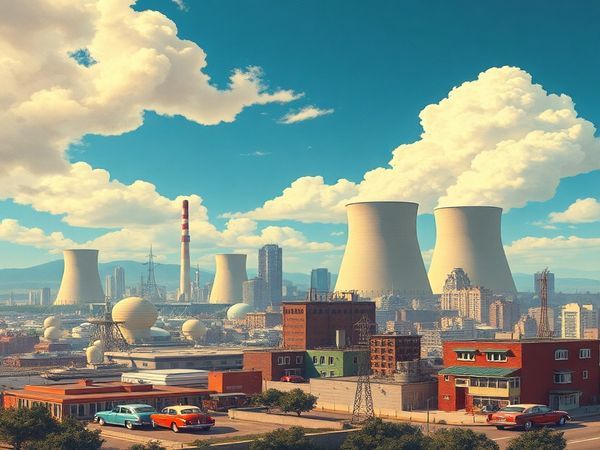
The atom had broken open a new world. With nuclear science marching from the obscurity of laboratories into the forefront of public consciousness, visions of cities powered by the splitting of atoms became widespread. Here in this era, atomic energy was often viewed with a mix of awe, fear, and optimism. Scientists and futurists imagined a world where nuclear power plants would dot the landscape, providing limitless clean power to burgeoning metropolises and sprawling suburbs. Films and science fiction seized upon this idea, depicting societies where energy was so abundant that it almost seemed free.
In everyday life, the conversation was buzzing. Newspapers and magazines frequently published articles on nuclear energy’s potential, discussing how this revolutionary force might soon warm homes, fuel cars, and even power flights beyond our atmosphere. Popular mechanics magazines of the time were awash with illustrations of compact reactors fitted beneath car hoods or powering individual homes — technological marvels that conquered what was perceived as a major hurdle to progress.
Yet not everything revolved around the atom. Coal and oil remained the mainstay energy sources, and most people still heated their homes with these familiar, long-established fuels. However, there was an acknowledgment that reliance on such finite resources might not sustain the demands of the future. Discussions among professionals and utilities gurus mulled over hydroelectric power projects as well; the remarkable success of Grand Coulee and Hoover Dams fueled a belief in the potential of harnessing nature’s own forces.
Even within this excitement was an undercurrent of skepticism, as some worried about the risks of relying too heavily on one source or the dangers associated with nuclear materials. Nonetheless, cultural forces that prioritized progress, innovation, and a post-war return to normalcy quelled many of these fears, pushing society relentlessly toward its vision of the future.
The Reality Unfolds: From Dreams to Modern Energy Production
As the decades unfolded, the trajectory of energy production took paths both familiar and unexpected. Nuclear power did indeed become a significant part of the energy mix, albeit not in the ubiquitous, utopian manner envisioned by 1940s dreamers. By the 1970s, nuclear energy was responsible for a burgeoning percentage of electricity production in several industrialized nations. However, the promise of cheap and safe nuclear power was tainted by unforeseen challenges — accidents like those at Three Mile Island and later Chernobyl brought home the risks more glaringly than any science fiction forecast had prepared society for.
Meanwhile, oil experienced its moment in the sun. The post-war economic boom led to a reliance on oil like never before, transforming it into the fuel of choice for driving industries, powering vehicles, and heating homes. It dominated the 20th-century energy landscape, running far ahead of coal in the race to power the world. However, the oil crises of the 1970s brought an awakening, exposing vulnerabilities that connected world politics with the limits of fossil fuel dependency.
Renewables, which had been largely sidelined in the mid-century vision, began to gain attention near the end of the century. Solar and wind, initially deemed too inefficient, became increasingly viable as technology advanced, spurred by a growing consciousness about environmental sustainability and climate change. Today, they form a vital part of the energy discourse, presenting possibilities that were but footnotes in early futurist predictions.
Comparing the dreams of the 1940s to today’s energy reality reveals a blend of triumphs and missed marks. Nuclear power, though integral, didn’t quite replace all other forms of energy to the extent expected. Oil rose more than anticipated, dominating the century, yet also became a source of geopolitical tension. Renewables emerged as a force less because they were predicted to be and more because necessity drove innovation.
Insights from the Interplay of Expectations and Reality
Examining the gap between 1940s expectations and our current energy landscape teaches significant lessons about human foresight and the nature of technological evolution. One clear insight is the influence of cultural optimism fed by recent technological breakthroughs. The fascination with nuclear energy mirrored a deep-seated need to believe in transformation through scientific progress, a pattern visible throughout history with any groundbreaking discovery.
The visions of energy independence and endless supply reflected post-war ideals — aspirations for security, power, and self-sufficiency. Yet, these dreams were tempered by the realities of complexity and unforeseen events. Human imagination tends to frame the future using the paradigms of its present, resulting in projections that sometimes overlook the nonlinear nature of progress, where setbacks and surges can unpredictably shift the landscape.
Moreover, the technological focus itself, with its spotlight on grand schemes like nuclear power, edged out the quieter opportunities that germinated in the corner — solar panels and wind turbines that could provide decentralized and sustainable solutions. This underlines an enduring tendency to overlook slower, less dramatic solutions in favor of spectacular ventures.
Finally, reflecting on this narrative highlights energy production as not just a mechanic operation or a scientific pursuit, but a complex, intertwined story of people, politics, nature, and innovation. As society marches on, recognizing this multifaceted character is crucial. It reminds us that today’s energy decisions cast long shadows, shaping not just the power grid but the cultural and social dynamics of future societies.
In the unending dance between expectation and reality, understanding how we got to our present energy landscape invites us to tread wiser paths toward the futures we dare to dream.