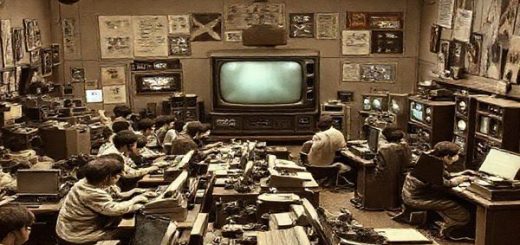
From Reverence to Rebellion: The 1950s Vision of Teachers’ Authority vs. Today’s Classroom Reality
The post-war world of the 1950s was brimming with dreams of a bright, shiny future, a future that was often envisioned through the eyes of optimism and boundless potential. People imagined new possibilities underpinned by scientific advancements and social shifts. Deeply intertwined with these dreams was the role of education, particularly the authority wielded by teachers. The way society imagined the future of teaching authority offers a fascinating window into the mindset of the era, revealing not only hopes and fears but also how strategic a role education was thought to play in navigating the complex emergent world.
The 1950s Vision: Teachers as Pillars of Society
Amidst the boom of the 1950s, a time characterized by rapid technological progress and suburban expansion, the teacher was envisioned as a central figure of moral and intellectual guidance. The post-war American landscape was a place of contradictions: vast optimism about technological potential was paired with fears of atomic annihilation; a focus on conformity was accompanied by growing currents of rebellion.
Teachers were seen as defenders of social order and conveyors of scientific rationality. In a world freshly dreaming of space exploration and atomic energy, educators were expected to be both torchbearers of knowledge and stabilizers in a rapidly changing societal landscape. Sci-fi films and literature often depicted teachers as wise guides, leading the youth into a new era of prosperity and peace, their authority unquestioned and their role essential.
In popular culture, the authoritative teacher figure was celebrated. Films like “Goodbye, Mr. Chips” idealized the teacher as a kind yet firm mentor, someone whose influence could change the course of lives. Meanwhile, school curriculums were evolving, seeking to prepare students for an ever more complex world that was just on the horizon. Teachers themselves felt empowered, often imbued with the moral authority to mold young minds in line with the ideals of democracy and freedom. This reflected broader societal values, with education seen as a pathway to innovation and security.
Professional discussions at the time emphasized the need for enhanced teacher training to match the expanding curriculum that now included atomic science, emerging technology, and a deeper understanding of world politics. The Cold War further fueled this emphasis, as American education was not just about domestic prosperity but national security. Teachers were seen as soldiers on the front lines of an ideological battle, administrators and policymakers ensuring that they had the tools needed to maintain order and pass on critical knowledge.
Across kitchen tables and at social gatherings, everyday people spoke of teachers with respect and reverence. The authority of educators wasn’t something to be questioned but celebrated, deeply entwined with the aspirations of creating a better, more informed citizenry. In the imaginative eyes of the 1950s, teachers were heroes of democracy, wielding chalk not unlike swords in a fight for a better future.
The Reality of Teacher Authority’s Evolution
Fast forward to the present, and the visage of teachers as supreme authorities and solitary guides of moral and intellectual virtue has shifted dramatically. The power and respect once assumed have been fragmented by waves of educational reform, technological change, policy shifts, and societal reevaluation of roles within educational systems.
Over the decades, the role of teachers has evolved, reflecting broader societal transformations. The educational reforms of the 1960s and 1970s began to question rigid authoritative structures. Civil rights movements and cultural shifts prompted a more inclusive and diverse approach to teaching, challenging the perception of teachers as sole arbiters of knowledge and increasing attention to student voices in educational dialogues.
The introduction of technology into classrooms, culminating in today’s widespread digital learning environments, further decentralized the authority once held by teachers. In this new landscape, the student became an active participant, seeking knowledge not just from teachers but also from digital resources available at their fingertips, leading to a more collaborative educational experience.
The teacher’s authority today is more about guiding, facilitating, and mentoring than directing with an iron fist. The expectations of being a moral and intellectual leader remain, but they are now shared responsibilities in a community of learners. Collaborative methods, project-based learning, and student-centered classrooms have replaced more didactic approaches, marking a significant departure from the mid-20th century expectations.
Interestingly, while the core notion of teachers being essential to shaping future generations remains intact, the way this role is perceived and enacted has become more complex. The teacher is no longer seen as an isolated pillar but a part of an intricate web of influences that include parents, technology, social media, and global cultural exchanges.
Learning from the Evolution
Reflecting on the differences between the 1950s vision and today’s reality offers profound insights into human thinking and the nature of authority in society. It demonstrates how expectations for the future are often tied to present conditions, with aspirational roles defined by immediate needs rather than long-term sustainability.
In the 1950s, the clear delineation of authority from teacher to student reflected a desire for order amidst uncertainty, a combat against chaos, expressed through a tightly-held vision of control and structure. However, as society evolved, so did understanding, embracing complexity over simplicity in recognizing that the future is not merely a reflection of aspirations but an unpredictable mosaic shaped by numerous uncontrollable factors.
The lessons here are significant. The shift in the role of teachers from bearers of absolute knowledge to facilitators in a broader learning ecosystem reflects a deeper understanding of authority as something that is co-created, negotiated, and shared. This change is a humbling reminder of the constant evolution required in educational philosophies to stay relevant and impactful in nurturing critical thinkers and informed citizens prepared for the future’s unpredictable nature.
While the 1950s vision coveted the teacher’s undivided authority, today’s reality underscores a more balanced approach, recognizing the importance of flexibility, adaptability, and open dialogue in educational environments. This transition speaks to a greater appreciation of diverse viewpoints and methods as foundational to nurturing creativity and innovation in new generations.
In conclusion, examining the past futurists’ visions juxtaposed with today’s reality enhances our understanding that human imagination is a powerful reflection of its time while also revealing potential pathways unexpected by those who came before. As we continue to re-imagine the future, learning from such comparisons can help shape more adaptable, inclusive visions that better prepare us for a world as full of unpredictability as it was when those earnest dreams first took flight in the optimistic skies of the 1950s.