1930s Visions of Rocket-Powered Sports vs. Today’s Tech-Driven Reality: Lessons from the Futures That Never Were
In the 1930s, the world teetered between tumultuous change and dazzling innovation, with cultural and technological shifts setting the stage for speculation about the future. Competitive sports, already a popular pastime and profession, became a canvas for the imagination of how human achievement might evolve. The shadows of the Great Depression lurked over cities and towns, yet the dreams of tomorrow burned brightly in the minds of those who saw sport as a beacon of resilience and progress. Let us venture back to this era of jazz, speakeasies, and grandiose dreams to glimpse how people of that time envisioned the future of competitive sports and how reality unfolded.
Imagining Tomorrow’s Competitive Thrills: 1930s Style
In the vibrant yet cautious atmosphere of the 1930s, people yearned for hints of a brighter future. Sports was no exception, capturing imaginations as a space where human limits could be pushed beyond the known horizon. With the world grappling with economic recovery and the looming threat of global conflict, the image of powerful athletes and thrilling competitions provided a reassuring picture of progress and strength. Visionaries foresaw unimaginable feats of athleticism, spurred by technological advancement and human ingenuity.
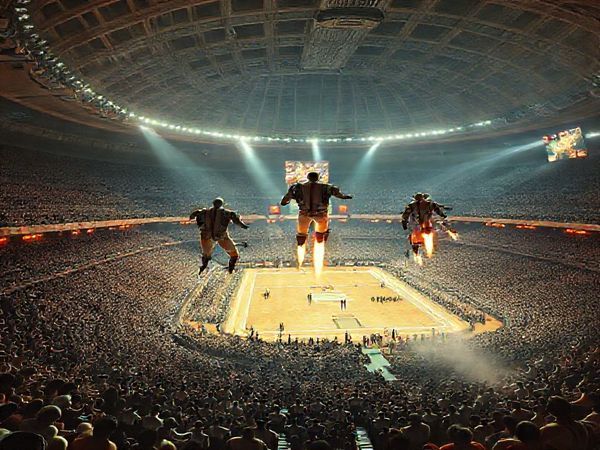
The era’s visionaries imagined sports becoming faster, more dramatic, and deeply intertwined with technology. There were futuristic depictions in popular media, such as science fiction stories and the burgeoning film industry, which captured audiences with scenes of athletes aided by mechanical enhancements, plunging into impossible feats. Writers speculated about athletes wearing mechanical limbs to jump higher, run faster, and push human capability to its pinnacle. Rocket suits were imagined as being incorporated into the Olympics, believing that technology would meld with the natural prowess of athletes.
In everyday conversations, sports fans envisaged arenas as vast, automated coliseums that could accommodate tens of thousands, featuring their favorite teams and bigger-than-life electronic scoreboards. Sports cars with streamlined curves and powerful engines were imagined domineering over the tracks akin to fierce gladiators in motorized chariots.
Professional discussions also carried a certain air of optimism. Enthusiastic predictions filled sporting journals, predicting international competitions conducted in ultra-modern stadiums, linked through innovations such as television broadcasts. Interestingly, there was a growing sense that sports would become more inclusive, with global events fostering peace and camaraderie among nations – a notion that felt especially poignant then, with geopolitical tensions rising.
Yet, some practical forecasters of the period tempered their idealism with realism. Doubts lingered about whether society would prioritize sports amid economic challenges. Could funding for such elaborate spectacles be sustained? These debates underscored a tension between technological optimism and socio-economic uncertainty.
The Reality of Competitive Sports: Past Aspirations Meet Present Achievements
Fast forward to today, and the landscape of competitive sports has indeed become a spectacle of human achievement and technological marvels, albeit in ways that the clairvoyants of the 1930s could not entirely predict.
While athletes are not leaping across stadiums with rocket assistance, technology plays a pivotal role in modern sports. Advanced materials in sportswear enhance performance, and analytics-driven training methods hone athletes’ skills to perfection. A futuristic vision did come true with technological enhancement, but in the form of data and materials rather than mechanical augmentations.
Sports stadia now do indeed exhibit the grandiosity imagined, with colossal structures like the Bird’s Nest in Beijing standing as modern-day cathedrals to human competition. These venues easily hold thousands and feature the latest in audio-visual technology, which bring audiences closer to the action whether they’re present in person or watching through high-definition broadcasts.
Perhaps the biggest surprise for the 1930s thinkers would be the immersive spread of sports via digital means. They imagined intercontinental engagement at a time when air travel was a luxury, yet today, fans across the globe come together through televised events and live streaming. Athletes’ feats are not just seen, but meticulously analyzed through slow-motion replays and a deluge of statistics.
Moreover, though not mechanical, the advent of performance-enhancing technologies, like biotech and nutrition advancements, have pushed the boundary of human capability, echoing some of the mechanical enhancements envisaged.
Yet, while these technological marvels surpassed expectations, some predictions remain unmet. The extreme robotic augmentations and spectacle-heavy sports primarily exist in the realm of fantasy leagues and video games.
Lessons from a Time Traveler’s Tale
The comparison between the visions of sports from the 1930s and today reveals insightful truths about human foresight and aspiration. It highlights how our imaginations during uncertain times hone in on elements that provide hope and strength – like sports. The futuristic expectations from the 1930s show how technological optimism was peppered with spectacle and fantasy far removed from reality.
This exercise in comparison reveals that while technical innovation often marches on, the social and cultural dynamics driving sports can lead to unexpectedly delightful divergences. Instead of isolated, futuristic arenas, sports have become a connecting thread within the human fabric, converging diverse cultures and ideas, allowing sports like soccer and basketball to gain international followings unimagined in the 1930s.
The ultimate lesson lies in understanding that the essence of sports – as a shared human experience – remains untouched even in the midst of rapid technological evolution. They continue to encapsulate dreams, defy limits, and evoke the enduring spirit of global camaraderie. Such a synthesis teaches us about the dual nature of predictions and reality, urging us to embrace foreseeable technologies while understanding that the core human experiences often remain timeless.
As we ponder future sporting possibilities, from AI-driven coaching to esports, we carry forward a certain humility, recognizing how past dreams and present realities forge the ever-unfolding road of human endeavor.