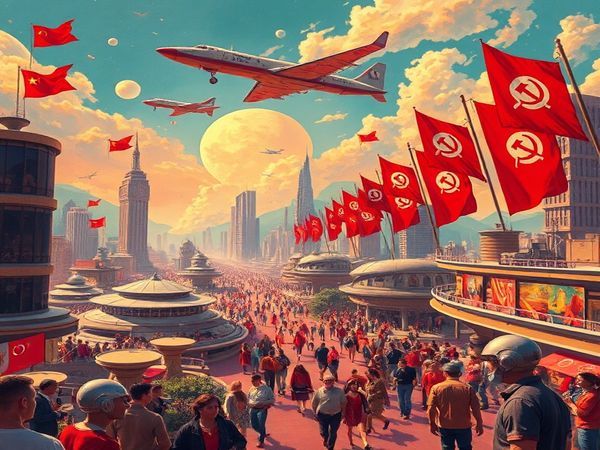
1960s Visions of Socialist Utopia: Dream vs. Reality and Lessons for Today
The 1960s was a decade defined by cultural revolution, space exploration, and a deep fascination with what the future might hold. Amid such vibrant change, the future of Socialism captivated imaginations, with predictions ranging from utopian visions of harmonious societies to warnings of bureaucratic stagnation. This period was marked by a unique intersection of optimism and skepticism, fueled by the contrast between the aspirations of the post-war world and the realities of geopolitical tension. It was a time when dreams of technological advancement danced alongside fears of nuclear confrontation, and Socialism stood at the crossroads of hope and caution.
Dreams of the Red Dawn: Imagining Socialism in the 1960s
In the 1960s, the world was gripped by the allure of Socialism as a viable and perhaps inevitable evolution of modern civilization. This period was characterized by immense faith in progress and a belief that ideological experimentation would pave the way toward a better future. Many believed that Socialism offered the perfect blueprint for a new era where equality and technological innovation would walk hand in hand.
For futurists, the predictions about a socialist world varied greatly but often shared a common vision of cities transformed by sleek modernist architecture, underscored by communal living spaces where everyone enjoyed equal access to resources. Some expected a world with centralized planning so efficient that it would eradicate poverty and hunger across the globe. These ideas weren’t confined to think tanks or academic circles; they spread through film and literature, coloring the public’s imagination. Consider how futuristic Soviet films portrayed their interpretation of Communism – not just as a political system but as a gateway to greater autonomy and equality. Spaceships bearing red flags soared across silver screens, symbolizing hope that socialism would lead humanity beyond Earth’s confines.
In everyday conversations, Socialism appeared as a counter-narrative to the capitalist model that had come to dominate American and Western European discourse. In coffee houses and university circles around the world, young people passionately debated the promises of Marxist thought and imagined a society where wealth and power were evenly distributed. These dreams painted future workplaces not as factories of exploitation but as oases of cooperation where scientific and technological advancements worked tirelessly for human prosperity.
The professional realm saw many economists and historians predicting that state-controlled economies, buoyed by technological advances and increased data processing capabilities, would outpace capitalist systems. With advancements in computing, experts argued that planned economies could optimize themselves beyond human error, ensuring resource efficiency and fairness. Publications like “The Economist” approached such predictions with nuanced analysis, reflecting the era’s ideological battle.
Yet alongside this optimism, Cold War tensions and the evident failures within existing socialist regimes cast shadows over these bright vistas. People keenly watched the Soviet Union, Cuba, and China – each offering their narratives of Socialism that differed starkly between ideological prospect and practical reality.
The Tangled Road of Socialist Reality
As the decades unfolded, the field of Socialism witnessed a scattered trajectory, leaving the 1960s’ idealized expectations in sharp relief. The collapse of the Soviet Union in 1991 marked a seismic shift as Marxist-Leninist states worldwide reassessed or abandoned their ideological commitments. The bright future depicted in earlier depictions faced dissolution into economic hardships, bureaucratic inefficiency, and political repression.
The socialist states that endured, like China, diverged from strict ideological paths, integrating market reforms to bolster economic growth. Today, China stands as an example of a duality that some 1960s futurists might find fascinating and baffling. While socialism as a political philosophy remains a cornerstone, its economy operates with a mix of state planning and market dynamics. The reality conflicts with, yet also partially fulfills, the dreams of past Soviet predictions for efficient, data-driven governance – albeit not quite in the description once imagined.
Across Europe, newly branded “Democratic Socialisms” flourished, becoming integral to policies in Scandinavian countries that managed social welfare systems aiming for equality and sustainability. These models appear as a halfway point between the unfulfilled promises of the 1960s and today’s complexities. Public services such as healthcare, education, and social security are more equitable in these countries, but they remain supported by market economies.
In retrospect, many of the technological applications enthusiastically associated with socialist ideologies in the past – like advanced computing managing resources or real-time data optimizing societies – belong more to the present computing and information age than to political structures, thus blending the lines between once antagonistic systems. We find ourselves in a world technologically capable of realizing several 1960s’ socialist dreams, yet driven by market incentives.
Unanticipated was the way globalization and the digital revolution would dissolve geographical and ideological barriers, creating a worldwide marketplace where ideas, capital, and data flow unfettered. The influence of the internet and digital communication served to democratize knowledge and access in ways that equitable distribution of social services once aspired.
Lessons from the Gap Between Dream and Reality
The stark contrast and partial convergence between past expectations and current realities of Socialism offer crucial lessons on how people think about the future. The optimism of the 1960s serves as a window into the human capacity to dream beyond perceived limitations. However, it also underscores how these visions often mirror the socio-political contexts of their periods.
Human predictions about the future are profoundly shaped by the present environment, making them as much a reflection of current hopes and anxieties as forecasts of inevitability. The challenges experienced by socialist states world over seem tied not only to theoretical ideological frameworks but also execution in the face of complexity beyond predictions. The dreams regarding Socialism from the 1960s reveal the timeless nature of the quest for justice, equality, and prosperity but remind us that systems are as effective as their adaptability to change and unforeseen technologies.
More broadly, the trajectory of Socialism shows that certain ideals can transcend original manifestations, adapting into hybrid forms that perhaps the 1960s thinkers envisioned in spirit if not in form. The reconciliation of market forces with social programs in democratic societies exhibits the persistence of socialist ideas in new, practical arenas.
Finally, this journey from expectation to reality teaches us about our limitations and potentials – how even when ideas do not unfold as once imagined, they still seed new developments and hybrids, illuminating paths forward in surprising and transformative ways.