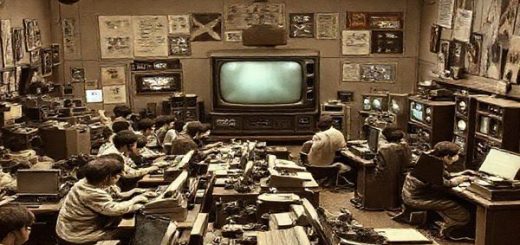
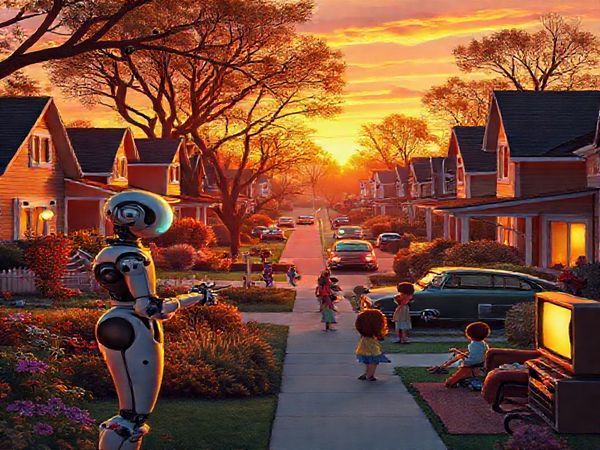
1950s Visions of Benevolent Bots: Revelations from the Past and Today’s Surprising Realities
In the glow of the post-war optimism of the 1950s, the world was a canvas of new possibilities. This was an era brimming with confidence that technology and human ingenuity could conquer the harshest challenges. As families settled into suburban life and television sets flickered in living rooms, the notion of helping others seemed destined for a revolution. People began to dream not just of flying cars or moon colonies, but of a future where being a good neighbor wasn’t just local and personal, but could be global and impersonal, driven by incredible new tools and ideas. Yet, what unfolded through the decades tells a story both of prediction and of surprise, as the path of helping others found new avenues beyond the imaginations of even the most forward-thinking futurists.
The 1950s Vision for Helping Others: Rockets, Robots, and Endless Optimism
Step back into the 1950s, and you’ll find a world much enamored with the idea that technology was the key to utopia. This was a decade filled with aspirations that rockets, computers, and robots could not only simplify daily life but make altruism more effective and universal. Newspapers, magazines, and television programs thrilled audiences with visions of machines that could alleviate human suffering. Imagine a world where robotic nurses would tirelessly tend to the sick, or where home appliances extended beyond the kitchen to offer comfort to those who struggled.
Futurists of the time were beguiled by the potential of automation and artificial intelligence, as nascent fields were explored with enthusiasm. They foresaw a society in which helping others would be less labor-intensive, thanks to these breathless advancements. Science fiction films, which captured the imagination of the mainstream audience, often depicted robots not as mere mechanical helpers but as partners in a new social fabric aimed at improving the human condition.
Outside cinemas and think tanks, everyday conversations reflected similar hopes but were grounded in more immediate contexts – the rise of charitable organizations and community efforts spearheaded by citizen volunteers. There was a belief that society itself, buoyed by economic prosperity, could shoulder the responsibility of bridging gaps in healthcare, education, and welfare. Neighborhoods fostered camaraderie, organized around PTA meetings and local events, with an undercurrent of the ‘we can do anything’ ethos. Professional discourse among social workers and educators began pivoting towards a future where centralized databases and communication networks would streamline aid efforts to those most in need.
The era’s optimism was palpable. This vision of helping others was not merely rooted in practical application but also in a sense of moral responsibility, an extension of the wartime spirit of cooperation, now pivoted towards peace-time goals. The expectation was clear – the future was bright, and it was the collective duty of society to help one another achieve it.
Reality Check: Progress and Surprises in Helping Others
As the decades unfolded, technology indeed became a central figure in how we help others, but not always in the linear way that the 1950s futurists imagined. Machines did become a crucial part of healthcare, with MRI machines and advanced surgical tools revolutionizing treatment. Yet, our robotic companions are, more often than not, tucked behind the scenes, quietly coordinating logistics or assisting with diagnoses rather than making rounds in hospitals as was vividly imagined.
As the internet surged forward, ushering in the digital age, the ways we help one another transformed in ways that few anticipated. Social media became both a platform for raising awareness about global causes and a means for individuals to support friends or distant acquaintances in need. The rise of crowdfunding presented a citizen-driven financial model unimagined by 1950s forward-thinkers, where support could be pooled instantaneously from countless individuals worldwide.
While traditional charities still play a significant role in aiding the less fortunate, the nonprofit sector has become more diverse, employing digital tools for everything from fundraising to logistics. This growth was neither straightforward nor predestined, as economic recessions and policy shifts reshaped how organizations could operate.
Moreover, some expectations were neatly met. The belief in stronger community cohesion found a decidedly different path; local initiatives are complemented by global connections, breaking the geographical boundaries that were once deemed immovable. Yet, the robot nurses remain largely a fantasy, not because we lack the technology, but because humanity turned out to mean more than mechanical precision.
In comparing predictions to reality, we find anticipated elements like the rise of technology interwoven with the unforeseen, such as the transformative impact of the internet. The outcome is a mosaic, with clear threads of expected technological development alongside surprising new patterns born from human creativity and need.
Lessons from Yesterday’s Tomorrow
The gaps and overlaps between what was envisioned and what came to be in the realm of helping others offer a window into the perennial human condition – our aspirations often reflect the concerns and limits of our time rather than those of the future. The 1950s exemplified limitless faith in technology but underestimated the organic evolution of civic responsibility and human connection that digital platforms would enable.
This exploration reveals how our visions of the future tend to magnify the tools at hand, projecting them forward without fully grasping the unpredictability of social evolution. It also underscores how technology is an extension of human values rather than a replacement for them.
The long-term meaning of helping others remains rooted in human empathy and moral responsibility, showing resilience even as forms of expression and methods of connection evolve. While tools and circumstances change, the essence of assistance – the shared willingness to reach out, to build up, and to empower – continues as a core human trait.
Reflecting on the predictions and the reality, we learn that while our dreams of future capabilities drive innovation, the unanticipated routes that help takes are often determined by the ever-changing tapestry of human relationships and values. It is a reminder that the future, while built from today’s blocks, is a complex landscape shaped by both intent and chance, where helping others will forever find new and meaningful paths.