From Space-Age Silhouettes to Power Suits: How 1950s Predictions for Women’s Fashion Compare to Today’s Reality
The 1950s were a time of hope and anxiety, of dazzling progress twinned with apprehensive glances toward an unknown future. In this world, shaped by the post-war economic boom and shadowed by the Cold War’s frosty specter, the imagination was free to wander toward futures teeming with innovation. This was particularly true in the realm of women’s fashion, where visions of sleek, practical clothing often rubbed shoulders with flights of fancy.
The 1950s Vision of the Future
To understand how people in the 1950s imagined the future of women’s fashion, we have to immerse ourselves in a time when televisions beamed “I Love Lucy” into living rooms and the aesthetic of “The Jetsons” seemed almost within grasp. This was a decade when people were looking up – quite literally – to the sky, dreaming of space travel, and translating that upward gaze into their vision of the future.
Culturally, the post-war era was a time when technology was bursting into everyday life. Appliances like refrigerators and washing machines didn’t just change homes – they changed expectations. If machines could take the grind out of housework, what could they do for the wardrobe? Futurists of the era speculated about garments made from synthetic, space-age materials that would never wrinkle, stain, or wear out. Predicting a sort of cybernetic wardrobe, thinkers imagined push-button transformations where a simple touch could change a dress’s color or style to suit any occasion.
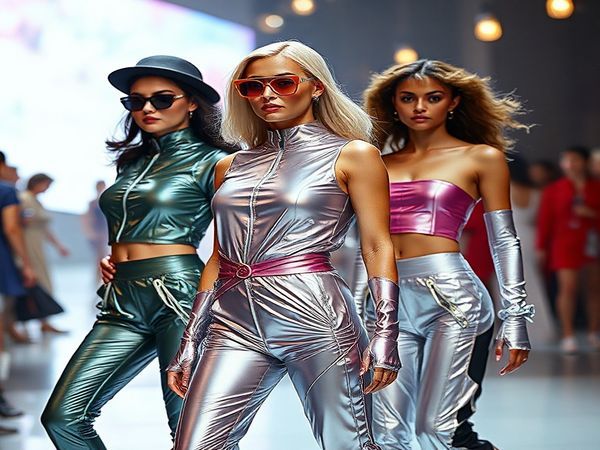
In the media, film and literature danced with these ideas. Sci-fi stories depicted heroines donning metallic jumpsuits or flowing fabrics with built-in technology. This was underscored by fashion features in magazines showcasing bold predictions of outfits designed in metallic, shiny materials, emphasizing aerodynamic shapes and futuristic motifs. The 1950s optimism merged with practicality envisioned a sartorial future where fashion was more than just clothing – it was an extension of futuristic living.
In day-to-day life, conversations buzzed with dreams of convenience. Housewives imagined an end to ironing, while young women fantasized about how new fabric technologies could free them from the constraints of their corseted pasts. Professionals in fashion and textile development attended conferences brimming with discussions of nylon, polyester, and Spandex, anticipating how these innovations might reshape the industry and, in turn, everyday wardrobes.
This vision was more than whimsy. It responded to an emotional undercurrent of the era – a longing for a future that promised to be more comfortable, efficient, and dazzlingly different. Yet, while we were on the cusp of modernity, the vision was not entirely unfettered: traditional gender norms and aesthetics still tethered these futuristic ideas to the familiar shapes and silhouettes beloved in the era.
The Reality of Women’s Fashion Evolution
Fast-forward through the decades and you’ll find that women’s fashion took a journey that was both representative of and a departure from 1950s expectations. The road was neither straight nor predictable, taking twists and turns that seemed, at times, to challenge the very nature of previous perceptions of evolution.
The 1960s swept in with a burst of color and rebellion. Gone were the demure skirts of the early 50s, replaced by the iconic miniskirt, bold patterns, and a celebration of youthful exuberance. While not exactly what 1950s futurists predicted, the exuberance marked an evolution in challenging dress norms. The 1970s and 80s further pushed boundaries, introducing a mix of natural fabrics with synthetics. Styles oscillated from bohemian to glam rock influences, making women’s fashion a powerful vehicle for expression and liberation.
One might think the notion of push-button clothing was relegated to fiction, yet elements like Velcro closures and adjustable, transformable garments did emerge and align with the futuristic thinking of those mid-century visionaries. By skipping forward to today, we find a rich tapestry of innovation still unfurling. Though we are not yet donning metallic jumpsuits as a rule, technology and fashion have indeed converged. Smart fabrics with embedded sensors monitor health metrics. Designers work with unimaginable textiles that adjust their structure or color, reflecting weather changes or even mood alterations.
There’s a fascinating duality here. The futurists’ belief in technology-driven clothing that simplifies, yet elevates everyday life, reflects in the boom of athleisure wear – clothing designed for comfort, powered by tech-driven textile advancements. Meanwhile, the spirit of self-expression – anticipated and revered by 50s visionaries as a hallmark of the future – shows in the diversity of styles accessible today.
Interestingly, the cultural and social predictions around women’s autonomy also came to pass, partially due to the changes in fashion expectations allowing for more practical and varied roles in society. Yet, no crystal ball foresaw the digital age’s role in democratizing fashion or the concerns of sustainability now embedded into modern clothing production.
Lessons from the Intersection of Past and Present
Reflecting on the dissonance between past expectations and present reality offers rich insights. First and foremost, it reminds us that predictions are inevitably reflections of their time, colored by the desires, fears, and limits of contemporary thought. The 1950s’ optimistic yet restrained futurism tells us much about a society on the brink of rapid change, eager yet wary of the unknown.
Women’s fashion, seen as a progression but also a reinvention, signifies more than just fabric and design. It is encapsulated within broader cultural dialogues about identity, freedom, and progress. The 1950s imagined a future where clothing could provide practical benefits and express individuality – a vision deeply rooted in the longing for post-war order yet yearning for personal freedom and self-expression.
As we negotiate our own ever-shifting landscape of technological advancement and cultural change, understanding how past generations envisioned our lives can evoke both humility and inspiration. It reveals how our humanity is eternally in pursuit of improvement balanced by tradition, comfort juxtaposed with remembrance.
In sum, while our visions of the future often fail to map perfectly upon the reality that later unfolds, they serve a higher purpose. They drive innovation and open minds to the possibilities that emerge at the intersection of imagination and reality. As in fashion, so too in the broader script of human progress.