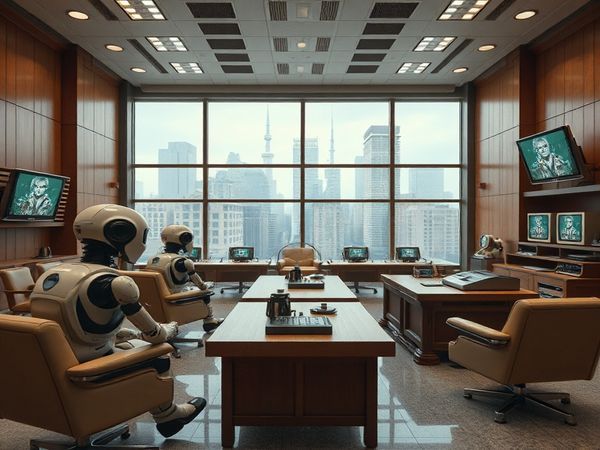
From Robotic Judges to Digital Courts: The 1950s Vision of Law Meets Today’s Reality
Stepping out of a time machine into the bustling decade of the 1950s, one might initially be struck by the optimism that characterized this era of post-war recovery and burgeoning technological advancement. Flush with hopes for a brighter future, people in the 1950s dared to dream boldly about the world that would emerge from the extraordinary innovations defining their time. From television sets flickering to the rhythm of change to automobiles roaring into new landscapes, everything seemed possible. That intoxicating possibility extended into realms less tangible but profoundly impactful – the law, an institution forever entwined with the fabric of society.
Imagining Tomorrow’s Justice: The 1950s Vision
In the thriving post-war culture of the 1950s, Americans had every reason to believe in tomorrow. The air was thick with expectations of scientific breakthroughs and utopian progress. The legal field, albeit more traditionally anchored, was not immune to these hopeful projections. Many believed that legal procedures would soon be revolutionized by technological advancements that were already glimpsing into society’s periphery.
The zeitgeist of the era was heavily influenced by advancing technologies. The television was not only transforming living rooms but was also seen as a possible window into future legal procedures. Some futurists predicted that trials could be broadcast, making the justice system more transparent and accessible. Ordinary citizens imagined watching trials unfold in real-time from the comfort of their homes – a kind of courtroom drama as engaging as any detective story unfolding on their screens.
In popular media, representations often flirted with the concept of automation. Movies sometimes depicted the courtroom of the future as streamlined and nearly mechanical places. The idea of robots reliably managing administrative legal tasks stirred excitement among some professionals. With computers just starting to enter the scene, the notion that they might one day handle the arduous task of sorting through mountains of legal documents seemed invigorating. In science fiction tales, the dream of a highly efficient, nearly error-free legal system fluttered at the edges of possibility.
Legal professionals also pondered the influence of machines in their domain. There was an expectation that as machines took on more mundane tasks, the entire legal process from evidence gathering to record keeping might be less susceptible to human error. Moreover, with countries like the United States expanding globally, establishing more consistent and rapid communication networks suggested that the legal world might soon be a smaller, more connected realm, able to respond more swiftly to international concerns. Such predictions seemed reasonable in a world that had recently harnessed the immense power of the atomic bomb and was racing towards space.
The Path of Legal Evolution: From Then to Now
Fast forward to today, the world of legal procedures has indeed seen significant changes from the 1950s, yet not always in ways anticipated by the futurists of the era.
The broadcast of court trials did become a reality, albeit more selectively than some had envisioned. Landmark cases like the O.J. Simpson trial captivated audiences worldwide, though not from the cozy confines of their living rooms as daily entertainment. Instead, live broadcasts of trials today are rare and typically deployed to provide transparency in proceedings that hold significant public interest.
Automated systems did find their way into legal practices but perhaps in more subtle ways than in the macroscale transformations of 1950s imaginings. The advent of the Internet revolutionized information storage and retrieval, making current legal databases a far cry from the dusty archives of mid-20th century law firms. Automation now assists in scanning and organizing legal documents, reducing but not eliminating human intervention.
Technology has also begun to influence courtroom presentations. Tools like digital forensics and e-discovery have modernized evidence gathering and presentation. Yet, the vision of fully automated trials where robots dispense justice with precision remains nestled safely in the arms of science fiction.
International law, meanwhile, has indeed evolved with globalization, benefitting from quicker communication and more uniform processes. However, rather than solely fueled by technology, this shift arose significantly from broader international cooperation and evolving legal frameworks that prioritized global collaboration over mere technological advancement.
Lessons from the Gaps Between Expectations and Reality
Evaluating the discrepancies between the 1950s vision of legal procedures and the contemporary reality provides intriguing insights into human nature and the trajectory of progress.
Firstly, the persistent disparity between human aspirations and technological execution underscores an enduring truth: predictions often tell us as much about the present as they attempt to reveal about the future. The confidence in machines of the 1950s reflected not just a belief in future efficiency but a deeper post-war optimism and faith in the power of human ingenuity.
This retrospective analysis also illustrates how deeply societal structures and human behaviors are embedded in non-technological fabrics. Legal procedures, for instance, are inherently linked to cultural values, ethical considerations, and deeply rooted traditions. Change runs accordingly slow, requiring not just technological prowess but profound shifts in collective human understanding and consensus.
The assessment also highlights the unpredictable trajectories of innovation, where dreams of radical transformation often yield to incremental, ubiquitous changes. The outcomes can be more quietly pervasive and restructuring, as seen with the gradual integration of digital tools into legal practices.
Ultimately, the exploration of the past and its visions illuminates a broader truth about the human condition: our futures are often predictably unpredictable, swirling as they do with aspirations shaped by present knowledge and imagination. Yet, they inevitably surprise us, consistently reshaping our understanding of both the possible and the actual. Tomorrow’s legal world will perhaps reflect the 21st century’s own expectations and anxieties – leaving one to wonder what the visionaries of today imagine about the distant courtrooms of the future.