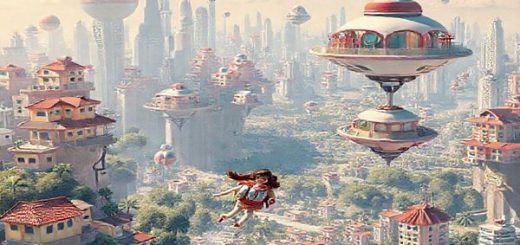
Faith in Tomorrow: Unpacking the 1920s Vision for Community and Its Echoes in Today’s World
The 1920s was a decade of complexity and contradiction, a time when the vestiges of the old world danced with the rhythms of a rapidly approaching modern one. It was an era caught in the whirlwind of post-war recovery, dizzy from technological and social revolutions, and it gazed into a future draped in both promise and uncertainty. Within this kaleidoscope of change, the questions of community and faith relationships catalyzed imaginative futures as society grappled with who they were and what they could become. This introspection unlocked a vibrant tapestry of futuristic visions, many of which would feel familiar even today.
The Dream of a Modern Community of Faith
The 1920s dawned with a vibrant optimism tempered by underlying tensions. The Great War had not only disrupted lives but catalyzed societal transformations. Communities that once seemed stable and perennial now felt transient and mutable, and with them, the place of faith within the public and private spheres underwent intense scrutiny. This era embraced the idea that technology and progress might construct not just cities of steel and glass, but communities connected through shared purpose and deeper spiritual understanding.
In the sphere of intellectual thought, futurists and thinkers began envisioning cities not just built from brick and mortar, but from the threads of human connection and spiritual exploration. They imagined that advances in communication could foster new forms of communal faith practices that transcended geographical barriers. Radio, which had become a household marvel, was seen as a tool that could knit disparate communities together, broadcasting sermons and religious debates into every home during the era’s silent Sundays.
Popular media painted its visions of the future with vivid strokes. Films of the era, though silent, spoke volumes about the human desire to connect and believe. Metropolis, with its towering edifices and stark social divisions, hinted at a future where technology could both isolate and unite, depending on how humanity chose to wield it. Meanwhile, popular literature tapped into community and faith with speculative fiction that speculated about utopian societies, where faith was a uniting rather than dividing force.
For the ordinary people of the 1920s, the changes were deeply personal. The mechanization of life, the electrification of cities, and the rise of the automobile challenged traditional modes of community. Church gatherings that had once been the backbone of social life struggled with declining attendance, even as they began to experiment with modernity’s tools – using telephones and radios to reach broader congregations. Public discourse often debated the coexistence of science and religion, musing whether spirituality could find harmony amid the mechanized sweep of the future.
Across board rooms and study groups, professionals speculated on how faith-based communities might sustain themselves through innovation. Some saw the potential for new ecclesiastical architectures inspired by functionalist design, predicting that community spaces would become multifunctional hubs for social and religious activities, adapting to the cultural zeitgeist of the era.
A Twisting Path Through Time
As the decades unfolded, the relationship between community and faith certainly did not progress in a neat continuity from the 1920s visions. The societal upheaval experienced then was not unique; the Great Depression and World War II were quick to follow, each shifting societal priorities. Communities and their faith relationships were buffeted by these winds of change, often charting crooked courses rather than the straight paths of human progress initially envisioned.
For much of the 20th century, growing secularization seemed initially to drive a wedge between faith and community life. Urbanization and technological advances – hailed as connectors – paradoxically contributed to a form of communal isolation where mega-churches sprouted alongside barren small-town parishes. The radio gave way to television, yet mass media often portrayed religion as antiquated in the face of modern scientific understanding.
However, in unexpected ways, the late 20th and early 21st centuries saw a re-convergence of sorts, as digital connections began to reinterpret community boundaries once more. Online platforms, for better or worse, became crucial meeting grounds for faith-based communities seeking to redefine themselves in the digital age. Podcast sermons and virtual prayer groups echo those 1920s dreams of radio-borne faith, albeit in a form far removed from their original conception.
Remarkably, some predictions about multifunctional community spaces were realized. Modern faith centers often house cafes, gyms, libraries, and support groups, blurring the lines between religious and everyday life in ways that would seem both familiar and strange to a parishioner from the 1920s.
Most notably, today’s community and faith-related conversations inevitably consider a wider global perspective, a dimension often absent in the more localized visions of the past century. Interfaith dialogues and collaborative spiritual initiatives reflect a widening horizon unimagined by prior generations.
Lessons on Vision and Reality
The act of comparing past expectations with current realities reveals much about humanity’s enduring quest to conceptualize the future. Visions from the 1920s serve as a mirror reflecting how individuals often link hopes and fears to the zeitgeist of their times, projecting current trends and desires on the blank canvas of tomorrow.
One principal insight is the adaptability of faith. It proves resilient to shifts in societal fabric, tuning itself to the technological and cultural notes of the era. The continual ability to reinterpret ancient truths through modern media – be it radio waves or digital pixels – highlights a profound human tendency to mold enduring aspects of identity within new contexts.
This interplay between expectation and reality underscores a common pattern: that human aspirations, while influenced by the promise of new technologies, rarely focus solely on progress for its own sake. Instead, they pivot around enduring questions of belonging, purpose, and shared understanding. Communities, bound by these questions, have proven to extend beyond the limitations initially forecasted, evolving in unexpected yet logical ways.
Hence, as we navigate our own uncertain paths toward the future, there’s a reminder that the future is not just a reflection, but a refraction – a bending of current realities through the lens of our dreams, hopes, and adaptations. With that in mind, the story of community and faith relationship continues to be written, an evolving tale that we narrate with each step forward, echoing dreams both past and freshly imagined, journeying onward in the shared human tapestry.