Dreams of Divine Evolution: The 1960s Vision of Faith and Our Modern Beliefs Unveiled
The 1960s were a time of radical change, a decade brimming with ambition, excitement, and a touch of apprehension about what lay ahead. Against a backdrop of space exploration, social revolutions, and technological marvels, the world began to reconsider its spiritual compass. As humans cast their eyes to the stars and their feet on the moon, some pondered: would our belief in a higher power evolve alongside our leaps in understanding and discovery?
1960s Visions: The Future of Belief in a Higher Power
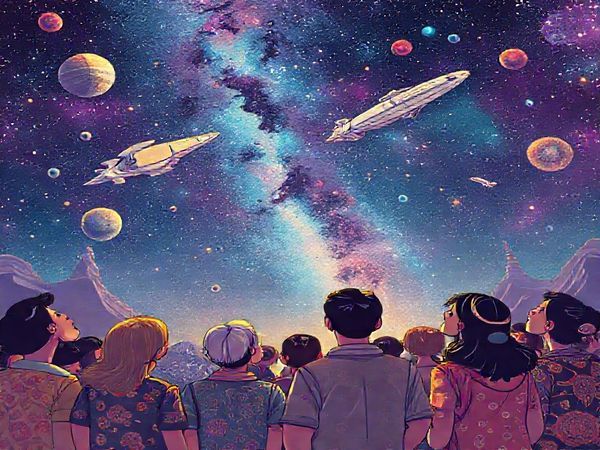
The 1960s were a kaleidoscope of change. Post-war optimism merged with countercultural movements, resulting in vibrant visions for humanity’s spiritual destiny. Futurists during this era viewed belief in a higher power in new, often experimental ways. Many foresaw a gradual spiritual evolution facilitated by technological and scientific advancements. With the Space Race in full swing, the discoveries made beyond Earth’s atmosphere prompted deep reflections about humanity’s place in the universe. Some scientists and philosophers hypothesized that contact with extraterrestrials could challenge or even expand conventional religious beliefs, potentially uniting humanity under a new universal faith.
Popular media of the 1960s echoed these sentiments. Films like “2001: A Space Odyssey” portrayed spiritual experiences intertwined with advanced technology, suggesting that futuristic societies might reevaluate traditional religious practices in light of new revelations. Meanwhile, novels such as Arthur C. Clarke’s “Childhood’s End” entertained the thought that our spiritual evolution could be shaped by interactions with far more advanced civilizations.
On the ground, in everyday conversations, people were abuzz with enthusiasm and skepticism about the future. The counterculture movement, which valued exploration of consciousness through both psychedelic experiences and Eastern philosophies, challenged traditional Western narratives around spirituality. Young people flocked to communes and embraced gurus, finding alternatives to conventional religious frameworks. In professional fields, discussions on theology and philosophy wondered if rationality and spirituality could coexist harmoniously, reflecting a desire to reconcile newfound scientific understanding with long-standing beliefs.
As cultural tides shifted, public expectations grew that technological advancements would either provide empirical answers to age-old metaphysical questions or delineate a new, pluralistic spirituality. It was a time of immense reimagining, where science fiction’s hypothetical futures seemed merely steps away from reality.
From Prediction to Reality: The Evolution of Belief
Fast forward to today, and we find a complex tapestry of spiritual beliefs that diverges in intriguing ways from those optimistic 1960s predictions. While technology indeed reshaped many aspects of life, belief in a higher power has proven both resilient and remarkably adaptable. The development wasn’t a straightforward march towards a singular vision but rather a dynamic and multi-threaded evolution.
Despite the expectation that technology might diminish the role of traditional religions, belief in a higher power remains robust globally. Surveys show that large portions of the population continue adhering to established faiths, though the practices and interpretations have grown more diverse. Intriguingly, technology has sometimes strengthened these beliefs: religious communities have leveraged digital platforms for growth and outreach, creating global connections that transcend physical boundaries.
Moreover, rather than being overshadowed, traditional spiritual practices have often appropriated advances in technology. Online religious services have made spiritual experiences more accessible, while social media has developed into a channel for theological discourse and community building. This evolution is far removed from the 1960s imagination of a science-driven spiritual renaissance, yet it reflects a deepened, albeit different, connection between technology and belief.
Conversely, some elements of the 1960s vision have indeed materialized. Interest in Eastern spirituality and meditation practices has seen a substantial rise. Mindfulness, a concept embraced within both secular and spiritual spheres, has gained widespread recognition and adoption in the modern world. Furthermore, global connectivity has facilitated unprecedented exposure to a wide range of spiritual and philosophical perspectives, fostering an environment where pluralism flourishes more vividly than ever envisioned.
Insights from Expectation and Reality
What can these swirling currents of expectation and reality teach us? One of the most revealing insights is that human thinking about the future often serves as a mirror reflecting present concerns, hopes, and fears. The 1960s optimism and expansive creativity were deeply intertwined with the era’s own zeitgeist, thus their notions of spiritual evolution reflected broader cultural ideologies rather than absolute forecasts.
Additionally, the evolution of belief in a higher power underscores its inherent resilience and adaptability. Despite swift technological advancement, the core human need for connection, purpose, and meaning has ensured that spirituality remains an integral facet of human experience. This illustrates that spiritual traditions are not merely stagnant relics but living practices capable of growth and transformation in response to societal change.
The divergence of reality from 1960s predictions also reminds us of the complexity in predicting human behavior and societal change. While outer space exploration captured imaginations, the inner spaces of human minds continued to navigate spirituality along multifaceted paths. Those who framed the future as a complete overhaul might have underestimated the enduring nature of fundamentally human experiences like faith.
Ultimately, the journey from the 1960s to the present teaches us that spirituality is neither static nor easily predictable. Its expression is as varied as the individuals who embrace it, molded by an interplay of culture, technology, and personal experience. As we look towards our own future, perhaps the greatest insight to carry forward is this: while the specifics of belief may shift with the winds of change, the human quest for understanding, transcendence, and unity remains a constant across the ages.
In essence, belief in higher powers remains a core part of the human story, as resilient and reflective of our nature as ever, constantly adapting and refiguring in the face of new frontiers. And perhaps that is the most enduring prediction anyone can make about the future.