1950s Dreams vs. Digital Realities: How Social Networks Redefined News
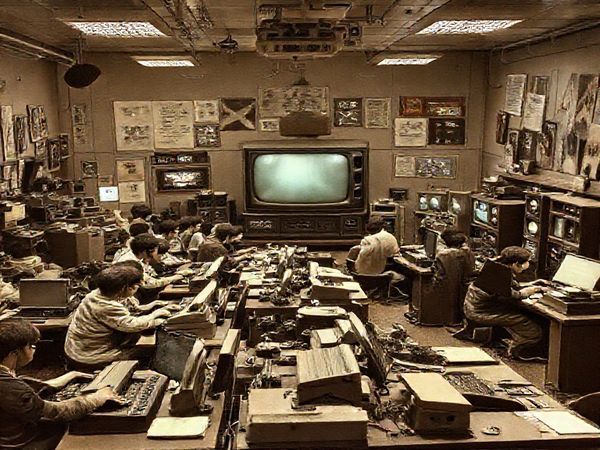
Step back into the sepia-toned world of the 1950s, a time buzzing with ambitious optimism and a touch of post-war realism. It was a decade marked by the clatter of typewriters and the rolling hum of newsreel projectors, where the concept of social networks was not yet about digital connections, but rather something tied more closely to social gatherings and burgeoning telecommunications. Looking to the future, people of the 1950s could only begin to imagine the transformations awaiting the world of news and information sharing.
Imagining Tomorrow’s Newsrooms: The Perspective of the 1950s
In the 1950s, the idea of a “social network” was not shaped by digital technology but rather the organic tapestry of human connections, woven from club gatherings, community events, and emerging media. The era pulsated with a fascination for futuristic themes, buoyed by post-war technological advances and the expanding reach of television. This was a period when the World’s Fair and sci-fi literature influenced dreams about techno-centric futures that would reshape the news landscape.
Futurists and science fiction writers, such as Arthur C. Clarke, offered bold visions of space colonization and advanced communication systems. In such tales, it was common to imagine news delivered through futuristic channels that were both instant and global. Yet, these imaginings often involved machines and contraptions rather than networks of people in a digital sense. The term “social network” likely would have conjured thoughts of telephone party lines, where multiple households shared a single phone line – a primitive yet communal mode of connectivity.
In cinemas, films often depicted clunky, blinking contraptions through which characters received messages. These gadgets were seen as distant fantasies rather than imminent realities. The idea that each individual might one day possess a portable device capable of accessing vast news networks was unfathomable. Instead, professionals in journalism of the time debated how television might complement or compete with newspapers and radio, more concerned with distribution methods than with any radical change in how networks of information might form.
For the layperson, discussions about the future of news were perhaps more muted. Families gathered around radios or watched black-and-white TV sets for their daily news – a communal experience that was the closest embodiment of a social network. While there were sure signs of anticipation at how technology could make lives easier and news more immediate, there was little in popular discourse about how this would transform the intricacies of social engagement itself.
The Real World: Social Networks Reshape News
Fast forward to the present day, where social networks have radically shifted the landscape of news dissemination and consumption in ways the average person in the 1950s could not have envisioned. Platforms like Twitter, Facebook, and Instagram are not merely communication tools; they are the modern infrastructure of social connectivity and news distribution. The evolution of these networks drastically changed not just the delivery but also the creation and perception of news.
The journey toward today’s interconnected world was not linear. The rise of the internet in the 1990s introduced a decentralized approach to information, attracting a flourishing of online blogs and forums that began chipping away at mainstream media’s monopoly on news. By the early 2000s, social networking sites began to break ground, effectively creating a new kind of public square. On these platforms, news could circulate freely, sometimes uncontrollably, with ordinary individuals acting as both recipients and dispensers of information.
This evolution highlights striking contrasts and parallels with those early visions. While the rapid delivery and global reach of news were somewhat anticipated, the democratization of news creation and the influence of virality were not. The power isn’t just in broadcasting; it’s in interaction. Networks today can sway public opinion, enact political movements, and even challenge democratic processes in ways that are profoundly complex and globally impactful.
Lessons from Looking Backward
Reflecting on the gap between 1950s forecasts and today’s reality offers intriguing insights into human perception and the nature of change itself. It tells a tale as much about imagination as it does about unforeseen possibilities. People often envision the future as a more advanced version of present realities, driven by the technologies and social frameworks they know.
The 1950s minded the logic of mechanization and transmission over the nuanced concept of interactivity and feedback made possible by social networking of the twenty-first century. The “future” imagined then was less about swirling data clouds and more about fast-tracked human processes. This reveals that our expectations of the future often mirror our current experiences, lacking the serendipitous developments that alter foundational paradigms.
Moreover, the unexpected rise of the digital realm underscores the sheer unpredictability inherent in forecasting. Advances in technology often sprout new behaviors and values, expanding cultural landscapes in unimaginable ways. This realization encourages an openness when imagining what is to come – an invitation to not anchor solely in current paradigms but to appreciate the potential for convulsive shifts.
In conclusion, the roadmap from the imagined futures of the 1950s to today’s reality of social networks redefining news reveals the wonder and limitations of human foresight. While some aspects aligned – the pursuit of immediacy and connectivity – others diverged wildly. This underscores a humbling truth: the pathway to the future is a mix of vision, surprise, and the ever-present capability for transformation that technology injects into human life.