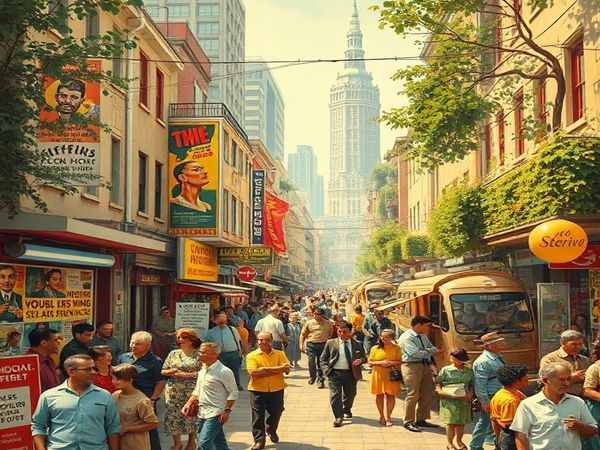
1960s Dreams of Ending Poverty: Where Vision Met Reality and the Lessons We Learned
In the swirl of cultural revolutions and scientific breakthroughs, the 1960s was an era suffused with optimism and idealism, shaping not just the present but also bold dreams of a transformed future. In this buoyant atmosphere, people began to cast their thoughts to one of humanity’s most entrenched struggles: poverty. While exploration of space and technological marvels captured the public’s imagination, there was also a burgeoning belief in eradicating global poverty—one of the most persistent blights on human progress. Through the collective lens of policymakers, futurists, and ordinary citizens, there emerged an intricate tapestry of hopes and predictions about a future freed from economic want.
Imagining the Future of Poverty in the 1960s
The 1960s were steeped in a heady combination of technological optimism and social consciousness. The decade was defined by a firm belief in human progress, reinforced by rapid advancements in technology and an expanding understanding of social justice. Riding the waves of the post-war economic boom, many individuals in affluent western countries saw poverty as a solvable problem, a relic that would fade away with increased industrialization and the spread of technologies that promised abundance. Similarly, the optimism prompting nations into space exploration fueled a confidence that terrestrial issues, like poverty, could be tackled with similar vigor.
The spirit of the era was captured in the ambitious vision of economists and intellectuals who forecasted a world where automation and increased productivity would lift all boats. Influenced by Keynesian economics, there was a strong belief in the power of government intervention to create employment and stimulate economic growth, thus eliminating poverty. Policymakers envisaged a future where every household would have access to modern conveniences, and emerging welfare states promised to provide a safety net against economic ruin.
In popular culture, science fiction films and literature echoed these sentiments. The futuristic worlds depicted in 1960s media often featured societies that had moved beyond poverty, presenting a utopia where material needs were effortlessly met. This was partially due to the influence of the countercultural movements, which, while critical of mainstream materialism, envisioned a more egalitarian society that could harness technology to create abundance for all.
Ordinary conversations were similarly infused with this optimism. As new appliances and technologies entered homes, they sparked imaginations about future living standards. The notion that scientific progress would continue its march, eventually eliminating manual labor and reducing economic disparities, was a common thread in this dialogue. People were not blind to the racial and geopolitical inequities of their time, but there was a pervasive belief that these too could be surmounted with enlightened policies and technological advances.
The Reality of Poverty Today
Fast forward to today, and the narrative around poverty is far more complex and multifaceted than futurists in the 1960s might have predicted. While the world has seen remarkable progress in many areas, such as life expectancy, literacy rates, and technological accessibility, poverty remains a stubborn issue, stubborn as ever in certain regions.
Significant strides have indeed been made. Since the 1960s, global poverty rates have decreased, particularly in Asia, where economic booms dramatically uplifted living standards for millions. Innovations in agriculture, medicine, and information technology have improved the quality of life across the globe. Yet, counter to the predictions of a poverty-free world, the economic divide has grown sharper in many areas, with wealth concentrating in fewer hands, often exacerbated by global economic policies.
Predictions about automation replacing human labor did come true to some extent; however, rather than eradicating poverty, it created a new set of challenges. While some industries saw productivity soar, others faced job losses and economic displacement, particularly in traditional manufacturing sectors. This unforeseen consequence led to disparities in job markets and communities left behind in the wake of globalized trade and technological advancement.
Contrary to the smooth predictions of the 1960s, the road to eliminating poverty has been rocky and uneven. The rise of welfare states in developed countries was matched by uneven efforts and political will across the globe. Some regions leveraged their resources to create robust social safety nets, while others struggled with corruption and inefficiency.
Unexpected disasters, like global financial crises and pandemics, have further complicated this landscape, often shifting progress backward in a jarring reminder that poverty is deeply tied to issues of governance and global stability.
Lessons from Hindsight
The mismatches between the visionaries of the 1960s and today’s realities offer valuable insights into the nature of human expectations and the trajectory of social problems like poverty. First, it illustrates that futurists often underestimate the complexity and interconnection of global issues. While the strides in technology and productivity met many dreams, they failed to account for the accompanying challenges of inequality and displacement.
The history of predicting poverty’s eradication underscores a common human trait—our projections of the future often reflect the aspirations and limitations of our own time more than the possible realities ahead. This tendency reveals a critical lesson: real solutions demand nuanced understanding and adaptability rather than unwavering faith in progress.
Moreover, the enduring challenge of poverty highlights the requirement for a multidimensional approach. Economic growth alone cannot solve poverty without addressing systemic inequalities in education, health, and access to resources. The 1960s vision lacked an awareness of the broad spectrum of human needs beyond economic metrics.
Finally, the enduring battle against poverty continues to inspire innovation and adaptation. The realization that economic systems need continuous reconsideration and reformation to ensure equitable growth leads us to appreciate that solutions must evolve. Poverty requires persistent, dynamic efforts—which include not only technological innovation but also social, political, and ethical considerations.
In looking back at the expectations of the 1960s, we uncover more than a lesson in forecasting. We find a mirror reflecting both optimism and oversight—a narrative that still fuels our quest for a world without poverty, urging us to dream and, crucially, to plan with greater wisdom for the complexity of tomorrow.