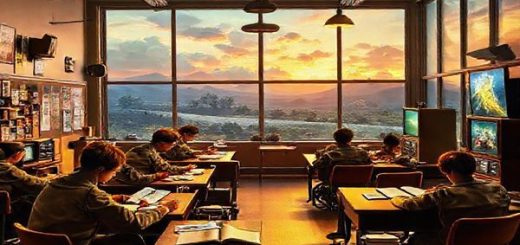
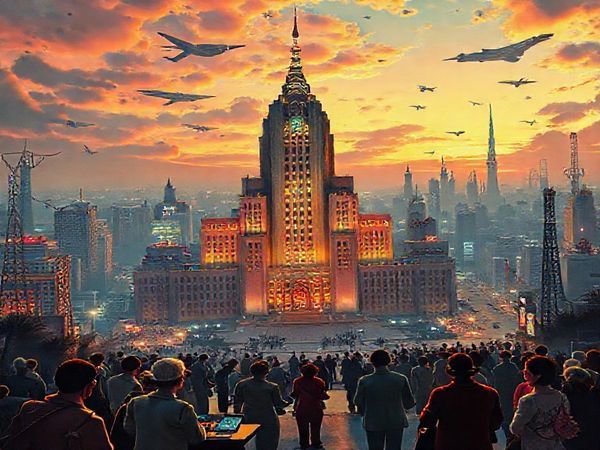
1940s Visions of Tomorrow: Predicting Politics, the Actual Evolution, and Lessons from History’s Guesswork
In the years immediately following World War II, the world stood at a crossroads, peering into a future shaped by the ashes of conflict and the dawn of unprecedented technological change. It was the 1940s – an era defined by recovery, optimism, and burgeoning visions of what society could become. At the heart of these visions lay profound questions about governance and the forms of government that might steer humanity through this new and uncertain era. While memories of tyrannical regimes were fresh, there emerged a mosaic of hopes and anxieties that colored how people imagined the future of political systems.
Imagining Tomorrow: The 1940s Vision of Governance
As the 1940s unfolded, the imagination of the future took root in fertile soil – one sowed by global upheaval and tremendous societal change. In the United States and across Europe, the specter of totalitarian regimes lingered ominously, a recent history that loomed over discussions of what the future of governance might entail. Those who experienced the war firsthand were often cynical about centralized power, fearing the ease with which it could morph into tyranny. Meanwhile, the victors, hopeful yet cautious, saw democracy as both a fragile achievement and a beacon of promise.
Futurists of the era were animated by the prevalent belief that the atom – the force both destructive and potentially utopian – would somehow manifest in new political structures. With nuclear energy poised to transform human capabilities, some theorized about a world governed by enlightened technocrats, where decisions were made on the basis of scientific rationality, thus minimizing irrational human fallibility. This vision often depicted a world where complex problems were solved through cold, logical efficiency, overseen by benign, almost machine-like rulers.
Hollywood, a barometer of public sentiment and imagination, also reflected and shaped these visions. Films like “The Day the Earth Stood Still” highlights fears and hopes tethered to extraterrestrial intervention as an ideal, almost utopian, governance model – overseers from beyond bringing peace through superior power and intelligence. Such themes resonated with audiences weary of human conflict and keen to entertain the notion that perhaps an outside force could succeed where humans had failed.
In the corridors of power and intellectual gatherings, debates raged about the merits of world government as a method to curb future conflict. Influential thinkers like Einstein and Churchill publicly entertained ideas of a United Nations-esque global body with real authority. In cafes and living rooms, ordinary people pondered the possibility of a future where sovereign nations surrendered some measure of power to a greater global entity, all in the name of peace. These conversations were laden with a mix of hope for a unified world and anxiety about the potential loss of national identity.
Even as discussions of supranational government lingered, the dawn of the Cold War commenced, effectively splitting global imagination along ideological lines. The ideological battle lines between communism and capitalism also drew stark contrasts in imagined futures: one side envisioning workers’ states and council-based decision-making, the other advocating for free markets and elected democracies. Each vision offered its version of utopia – egalitarian society on one hand, personal freedom and prosperity on the other.
The Path Traveled: From Yesterday’s Dreams to Today’s Realities
As history marched on from the 1940s, the landscape of governance unfolded in ways that few had predicted. The latter half of the twentieth century into the twenty-first saw both continuity with the democratic expansions once hoped for and divergence in paths no visionary precisely foresaw.
The supranational bodies predicted by some thinkers of the 1940s did take shape, yet the United Nations became more a forum for discussion than a robust global government. Despite noble aims, it struggled for power and effectiveness, a reflection perhaps of the realities of national interests and sovereignty that proved more resilient than many had thought. However, the ideal of global cooperation persisted, influencing gradual developments like the European Union, which dared to tread further in sharing sovereignty, but still stopped short of becoming a fully unified political entity.
Meanwhile, the Cold War catalyzed political evolutions across the globe, vastly overshadowing hopes for a peaceful, technocratic governance structure. Instead of futuristic serenity, the latter half of the century endured continuous political tension, military standoffs, and proxy wars that defined global events much more than any particular form of government ever did.
Moreover, the ideological tug between communism and capitalism, which heatedly occupied the hallways of the 1940s imaginations, unfolded into visible, practical tests across nations. Eastern Europe and the Soviet Union’s eventual pivot towards democratization and market economies shattered the implicit destiny of a workers’ utopia, showcasing limitations of coercive, top-down governance. Conversely, the resilience of capitalist democracies suggested the durability of governance forms that many in the 1940s saw as susceptible to decline.
Socially, movements for civil rights helped redefine and reshape democratic ideologies to address long-overdue inequities, something optimistic 1940s pundits might have believed possible but would be struck by how hard-fought these victories proved to be. In many ways, these changes were a testament to governance adapting – slowly and painfully – toward those ideals envisioned, albeit haphazardly, during their time.
Lessons Through Time: Understanding Human Visions of Power
What, then, does reflecting on the 1940s visions tell us about the nature of human foresight and government evolution? Primarily, it reveals the way futurists from any era remain bound by the horizons of their present. The 1940s carried the weights of world conflict and the promise of atomic wonder, which invariably colored politically imaginative outputs. It is a reminder that visions of the future often serve as mirrors reflecting concerns rather than windows revealing destiny.
The discrepancies between expectation and reality shed light on the unpredictability of human affairs and the complex nature of governance. Just as technology and societal norms shift, so too does governance, to both external pressures and internal transformations. The unfolding of governance is less a strict trajectory and more an intricate dance of experimentation, adaptation, and lessons learned.
The allure of scientific and technocratic governance might highlight humanity’s perennial desire for control and reliability over the unpredictability of human politics, but history shows that the strength of construct lies in flexibility rather than rigidity. Rule by humans – flawed and diverse – continuously shapes governments to be unpredictable yet enduring.
Reflecting on this historical account suggests that effective governance must balance stability with responsiveness, echoing the democratic experiments of the past century which showcase adaptability as strength. Perhaps it reminds us that the real progress lies less in reaching a final perfect form and more in continual evolution, bending ever towards more inclusive, just governance structures as our history unfolds.