From Reverence to Relevance: 1940s Visions of the Church’s Future and Today’s Surprising Reality
In the swirling world of the 1940s, amid global tumult and the hurdles of post-war recovery, the future was a canvas painted with bold strokes of hope and anxiety. The emerging vision about the status of the church was no less vivid, colored by the cultural and emotional landscapes of a profoundly pivotal era. The 1940s was a time when people, grappling with the shadows of war, sought solace in religion while simultaneously questioning its place in the modernizing world.
Envisioning the Future: The Church Through the Eyes of the 1940s
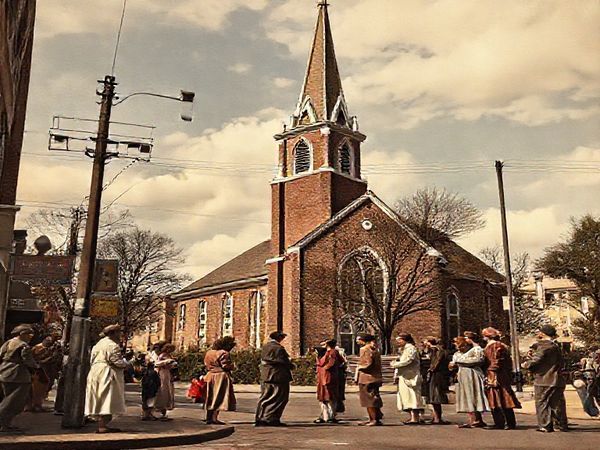
Picture yourself in the heart of the 1940s, an era marked by seismic shifts. The global community stood at a crossroads following the devastation of World War II. Against this backdrop, the future of the church was contemplated through a kaleidoscope of possibilities. For many, the church represented moral stability in an uncertain world, its steeples rising above the fray of political ideologies and the noise of technological advancements.
Futurists of the time, influenced heavily by the recent horrors of war and the rapid advancement of technology, speculated widely on religion’s role. Some imagined the church preserving its pastoral tranquility, maintaining community cohesion through shared values. Others envisioned a more adaptive institution, one that might harness radio waves, and perhaps one day television, to spread its message beyond physical walls. The war had showcased technological prowess, and there was a burgeoning belief that the church could become a more dynamic force in this brave new world.
In the movies and popular culture of the era, the church was often depicted as a bastion of good against evil. Consider films like “Going My Way” and “The Bells of St. Mary’s,” which portrayed clergy as compassionate leaders confronting the changing tides of the modern age. These narratives reassured audiences of the church’s ability to guide them through societal transformations with wisdom and warmth.
Ordinary discussions around kitchen tables and at church social gatherings were also infused with reflections on religion’s trajectory. Families spoke of faith as a constant in a world that had, quite literally, been blown apart and reshaped. Yet, there lingered a sense of curiosity, with some questioning whether the church could meet the demands of a world hurtling towards suburban development and technological progress. Professionals, from sociologists to theologians, debated whether the post-war era would see a religious revival or a decline as prosperity resumed focus on individual pursuits over collective faith practices.
The echoes from these conversations and media reflections painted a future where the church was to either evolve alongside burgeoning social trends or risk being sidelined by an ever-accelerating progress narrative. To many, the church stood at the cusp of renewal or decline, and the world held its breath to see which path it would take.
The Reality: How the Church’s Role Has Evolved
Fast-forward to the present day, and the church has indeed traveled along a complex path. The post-war period saw a religious revival in many parts of the world, especially during the 1950s, with church attendance peaking in places like the United States. Families, reuniting after turbulent wartime separations, often found comfort in religious community activities. This seemed to fulfill some 1940s predictions of a continued or even enhanced role for the church.
However, by the 1960s and 70s, the story took an unexpected turn. Secularization flooded Western societies, with colossal shifts in cultural norms challenging the church’s traditional doctrines. The sexual revolution, civil rights movements, and a growing counterculture began to redefine public values. The church faced critiques from within and without to adapt quickly to a changing world.
In recent decades, the church has both contracted and transformed. Attendance in conventional services has waned in many areas, making earlier predictions of sustained mass gatherings less accurate. However, the rise of digital media has breathed new life into religious experiences. Megachurches, televised sermons, and online services have reinvented the traditional church model, in ways that could not have been entirely predicted in the 1940s but influence today’s religious participation profoundly.
Beyond attendance and media, there have been fundamental shifts in how many denominations address social issues. The church today is more varied, with many branches embracing reforms on gender roles, social justice, and inclusivity, manifesting a level of adaptability suggested by more prescient futurists of the mid-20th century.
Lessons from Comparing Past and Present
Reflecting on the great divide – and the surprising points of convergence – between the expectations of the 1940s and today’s reality offers several valuable insights. One key lesson is that our visions of the future fundamentally reflect our hopes and fears of the present. For those in the 1940s, weary from war and thrilled by emerging technologies, the church was a symbol both of comfort and of caution in what was yet to come.
This examination also reveals something profound about the enduring, yet adaptable nature of religion. The core aspirations for moral guidance and community haven have persisted, even as the modes of religious practice and organization have subtly and sometimes radically shifted. Predictions that might have suggested a wholescale abandonment or an unwavering hold over people’s lives were simplistic when faced with the nuanced realities of human existence.
Further, the story of the church reminds us of a significant human tendency: to underestimate how much we will adapt to change. The church’s trajectory has been one of both decline and resilience, illustrating adaptability’s critical role in enduring relevance.
Ultimately, the church’s journey from the 1940s to today reinforces an essential truth. Even amidst rapid societal changes, humanity continually seeks out connection and community, questioning and reimagining institutions to better reflect the spirit of the current age. In understanding these shifts, we gain insight not only into the future of religion but into the broader canvas of human development.
In conclusion, while predicting the future often leads us to focus on dramatic shifts, it’s often the nuanced, quiet evolutions that truly shape our world. The church’s history teaches us to respect the enduring elements of human connection, showing that even institutions with ancient roots can find ways to resonate with modern minds.