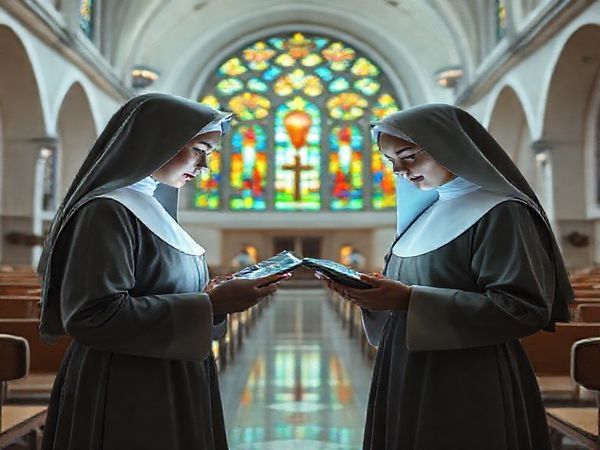
1940s Dreams of High-Tech Habits: Reimagining Nuns’ Futures and the Surprising Realities
As we step back in time and immerse ourselves in the vision of the future conjured by the 1940s, we encounter a world captivated by both the marvels and the aftermath of World War II. This era was painted with surreal juxtapositions – the optimism of technological progress clashing with the sobering realities of conflict and reconstruction. Amid this broad canvas of global change, the contemplation of more spiritual aspects of life, such as monasticism and the roles of nuns, took on both an intriguing and imaginative lens. People of the time speculated how these age-old vocations would adapt to – or resist – the tides of modernity.
1940s Visions: The Future of Monasticism
In the 1940s, the world was on the brink of transformative changes. The post-war period was a time of rebuilding and reimagining nearly every facet of life. This period also fueled imaginative guesses and sometimes whimsical predictions about the way societies would mold themselves. Among the lesser-explored areas of such speculation was the future of monastic life and the role of nuns in a rapidly evolving world.
At the heart of these imaginings was a society grappling with the rapid advancement of technology and modernization. The growth of cities, widespread adoption of electricity, and a burgeoning fascination with science fiction encouraged people to think about the drastic changes that might reach even the most traditional and secluded corners of life, such as monasteries and convents.
Futurists—or those who dared to imagine beyond the immediate—often predicted that monastic life might become obsolete as the bustling nature of the modern world left little room for such quiet contemplation. Would nuns and monks abandon cloistered life for the excitement of modern careers? Could robotic helpers aid in spiritual practices, or might new inventions facilitate a cloistered life more closely connected with the rest of the world than ever before?
In popular media of the time, such as films and literature, monks and nuns were occasionally depicted in light-hearted scenarios where the ancient met the modern. While serious contemplation of religious life wasn’t the mainstay of media, these depictions revealed an everyday curiosity about how deeply entrenched traditions might meet the era’s technological progress.
Meanwhile, in their day-to-day lives, people pondered practical questions too. Ordinary conversations considered how religious orders might open up, influenced by the broader feminist movements gaining momentum. Would nuns still teach in schools, run orphanages, and work in hospitals, or would they find new vocations? In academic and professional circles, religious scholars speculated about changes in doctrine, potentially influenced by increasingly vibrant dialogues on ethics and humanity ushered in by scientific discoveries and moral philosophies stemming from the war.
Monasticism’s Present Path
Fast forward to today, and the actual trajectory of monasticism and the lives of nuns reveals a tapestry that is both anticipated and surprising. As we reflect, we see that predictions about monasticism’s demise were premature; instead, it has undergone its own adaptation.
In the mid to late 20th century, monastic communities did indeed face declining numbers. This was partially due to the increasing secularization of societies around the world, along with the growing opportunities and options available to women outside the confines of religious life. However, rather than vanishing into obscurity, many religious communities embraced change. Orders began opening their doors wider to laity, inviting lay associates to participate in the spiritual life without full commitment.
Modern nuns can be found not just in cloisters but living in community apartments, working in diverse fields from social work to environmental advocacy. The visions of technology seen in the 1940s didn’t quite lead to robotic helpers in convents, but they sure brought about the digital world nuns navigate today. Many orders maintain online presences, reaching global audiences, showcasing the blend of ancient wisdom and modern tools.
Moreover, while traditional habits and rules still exist, many orders have adapted to include more culturally relevant attire and initiatives. In regions especially impacted by poverty and conflict, nuns have become crucial change-makers, providing education and health services and working alongside NGOs and governments.
The prediction that nuns would abandon traditional roles for modern ones was somewhat realized, yet in the service of their missions, rather than abandoning their callings. There’s an enduring strength and endurance in monastic life, an ability to adapt ancient principles to the changing world without losing the essence of contemplative life.
Learning from Our Predictions
The expectation-versus-reality narrative of monasticism reveals how often our visions of the future are shaped more by the zeitgeist of the present than the actual thread of history yet to be woven. Our 1940s predecessors, influenced by the immediate context of war recovery and fast technological innovation, imagined drastically different outcomes, some of which leaned into dystopian or utopian extremes.
We learn that human curiosity and imagination often envision changes that either overestimate short-term consequences or underestimate long-term adaptability of established institutions. The enduring nature of monastic life, for instance, tells us about the resilience of cultural and spiritual institutions, even under the pressure of modernization.
Furthermore, while predicting the exact future path is near impossible, the exercise of imagining is invaluable. It reveals what societies value, fear, and aspire to. The conversations from the 1940s say much about the period’s priorities, such as an eagerness to reconcile tradition with modernity and a fervent hope for a more equitable future.
In pondering the evolution of monastic life, we are reminded of the power of adaptation. Institutions and individuals alike carry their foundational beliefs forward, yet remain fluid enough to embrace change – a lesson of balance that seems more relevant than ever.
As we navigate our present while dreaming of our futures, history encourages us to hold onto the essence of our human spirit – adaptable, imaginative, hopeful. And perhaps, much like the nuns who found new ways to walk their old paths, we too can blend what is enduring with what is emerging, to craft futures that are rich, meaningful, and fulfilling in unforeseen ways.