Glamour Through the Decades: How 1930s Future Beauty Ideals Compare to Today’s Reality
Imagine stepping back in time nearly a hundred years to the bustling flapper craze of the 1930s, where jazz music filled the air and the world danced amid the Great Depression’s shadows. It was a time of stark contrasts – economic hardship juxtaposed with an eagerness for change, innovation, and cultural revolution. In such a world, how did people imagine the future ideal of beauty? Riding the waves of both despair and hope, society’s vision for the future often becomes a curious collage of wishful thinking and tangible potential.
Tomorrow’s Beauty: Visions of the 1930s
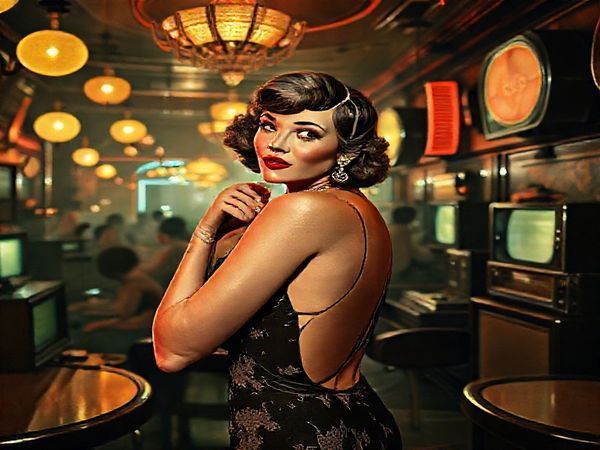
In the 1930s, the future of beauty was envisioned as both sophisticated and intensely futuristic. The era was marked by a fascination with streamline moderne, an art style that emphasized smooth lines and an aerodynamic style, reflecting a yearning for speed and optimism. This aesthetic found its way into how people imagined the future face of beauty. Women’s fashion and beauty ideals were heavily influenced by the Hollywood stars of the era. Silver-screen darlings like Greta Garbo and Marlene Dietrich offered a glamorous model of high cheekbones, slender eyebrows, and pronounced lips.
Technological advancements were already stirring the imagination. Radio broadcasts and early television sets began shaping and distributing a broader image of beauty. Futurists of the era speculated about the ways science might enhance human appearance. Some even mused on the possibilities of cosmetic surgery becoming more precise and accessible, allowing ordinary people to mold their features into desired shapes. Despite scientific limitations, the belief persisted that technology would someday enable everyone to look like film stars.
Magazines and beauty salons that promised transformation surged, buoyed by expectations of personal reinvention through creams, cosmetics, and burgeoning medical procedures. Everyday conversations among women often revolved around the little tricks and tips they could employ to mirror movie icons, dreaming aloud of what they might achieve “when the world improves.”
Socially, beauty was not just personal. It was political. As women demanded more rights and influence, they also claimed control over their appearance. The empowered flapper, with her shorter hair and skirts, became a symbol of rebellion and modernity. The haze of cigarette smoke in jazz clubs was not just a habit but an element of a new, independent allure.
In professional circles, beauty standards prompted varied discussions. For those in advertisements and marketing, the challenge lay in visualizing products that celebrated both present elusiveness and promised future fulfillment. Perhaps a cream could defy age or a lipstick could grant not just color, but confidence. For cosmetologists, the goal was innovation – developing techniques to deliver the glamorous transformation the public craved.
From Fantasies to Fragrance: The Evolution of Beauty Today
Fast forward to now: the 1930s vision of streamlined, starlet-like beauty has taken unexpected pathways. Today, diversity in beauty has gained ground, celebrated both in media and in society. While science and technology did evolve as prognosticated, enabling various enhancements and cosmetic surgeries, the broader narrative diverged from the singular starlet emulation to embrace individuality and inclusion.
Cosmetic surgery has indeed become more refined and commonplace, echoing those early fantasy forecasts. Techniques once limited to the rich and famous are now accessible to many. However, contrary to the singular mold once anticipated, today’s society encourages embracing one’s inherent uniqueness.
Digital connectivity, beyond the early intuitions of radio and television, now drives the beauty industry in ways the 1930s futurists could scarcely imagine. Social media platforms like Instagram and TikTok introduce an ever-shifting landscape of beauty trends. Influencers from diverse backgrounds highlight a range of looks, defying rigid standards and pushing boundaries formerly set by a concentrated media industry.
Interestingly, today’s trending skincare and makeup routines often focus on enhancing natural features rather than completely altering them. The beauty aisle offers products promoting ‘no makeup looks’ and ethnic diversity. While creams and cosmetics line the shelves as they did back then, today they are accompanied by promises of soothing natural components and ‘clean beauty’ marketing.
Where the 1930s held a monolithic cultural ideal often dominated by Western influences, current beauty realms recognize and leverage global beauty standards. The era’s simplicity dreamt of one aesthetic; now, the market celebrates a kaleidoscope of beauty ideals.
Unearthing Wisdom: Beauty’s Timeless Nature
The exploration of past predictions and present realities around beauty ideals uncovers core truths about human nature and perception. One fundamental insight is that visions of the future are deeply tied to the creators’ own needs, desires, and experiences of their present day. The 1930s predictions reflect optimism and a craving for control over identity amid widespread uncertainty. Yet, they also highlight a profound misunderstanding of progression – that societal ideals could remain static even as future means evolved.
This reflection reinforces that while technology can transform and enhance, true beauty’s ideals are often more about diversity, self-expression, and cultural reflection than uniformity. The way people perceive beauty is constantly reshaped by social attitudes, intersecting identities, and the push-pull of collective versus individual ideals.
What the 1930s dreamt in futuristic swells, we now live as myriad rich experiences that blend cultural influences across the globe. Understanding this helps us appreciate how beauty evolves not in isolation but interwoven with complex human narratives and interactions.
In essence, the grand ideas once harbored in the 1930s illuminate a timeless truth: while the surface – the skin, the procedures, the fashions – may change, the heart of beauty remains deeply personal, a reflection of one’s era as much as one’s self. As we keep projecting into the future, it is valuable to remember that while our tools may indeed change, our essence often remains much the same, woven from the dreams and stories that define us.