From Flying Doctors to Digital Doses: How 1930s Nursing Dreams Shaped Today’s Medical Reality
In the vibrant era of the 1930s, the march towards progress was an all-consuming fascination. The world stood at the cusp of transformative technological advances, with dreams of a future where human and machine would intertwine seamlessly. As the globe wrestled with the aftermath of the Great Depression, the collective imagination sought solace in tomorrow’s potential. This narrative is vividly seen in how people imagined the future of nursing, a field poised on the brink of change, shaped by the era’s unique blend of hope, reality, and speculative thinking.
Dreams of Tomorrow’s Nurse
To step into the 1930s is to step into a world where the future was both a promise and a puzzle. The decade was marked by a profound tension between nostalgia for simpler times and an embrace of the new. For nursing, a field already significant due to its vital societal role, this was a period of yearning for transformation into a more powerful, efficient force in healthcare.
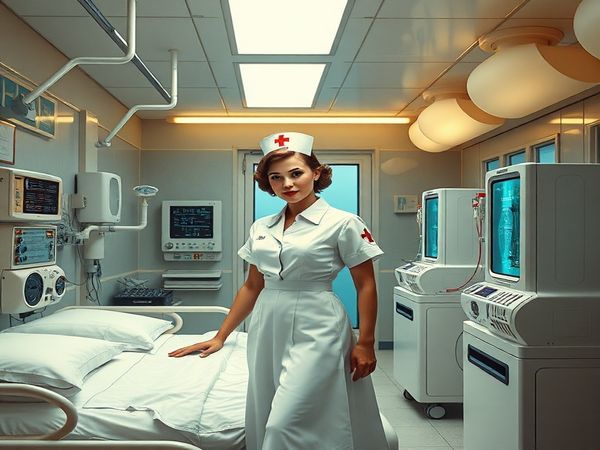
The futurists of the 1930s, armed with enthusiasm for burgeoning technologies, envisioned nurses as pivotal agents within a high-tech medical landscape. The possibilities seemed endless. To them, the advent of devices such as the electrocardiograph and early versions of dialysis machines suggested a kind of modern sorcery, with nurses as the skilled practitioners commanding this technology. They imagined hospitals transformed into futuristic spaces where nurses, working in tandem with sleek machines, would offer enhanced patient care far beyond what was known.
Popular media and films of the time occasionally depicted nurses as both nurturing caregivers and competent figures at the technological frontier. The portrayal leaned heavily on the emerging image of the “super nurse” – capable not merely of providing bedside care but managing sophisticated medical machinery. This vision was fed by broader societal trends, including the romanticization of technology and the rise of modernist aesthetics, which infused everything from cityscapes to the evolving hospital wards.
In everyday discussions, ordinary people layered these futuristic fantasies with their lived experiences and emotional realities. The nurse was often envisioned as a beacon of resilience, particularly poignant against the era’s backdrop of economic hardship. While some dreamt of robot assistants to lessen nurses’ heavy workloads, others pondered whether such technological advancements might dehumanize patient care, a conversation that persisted in kitchen table talks and social gatherings.
Professional dialogues within nursing began pushing the boundaries of what was possible. Nursing journals and conferences debated the potential for advanced education, enhanced specialization, and even the idea of “nurse administrators” who could manage entire healthcare facilities. Amid these dreams was a shared undercurrent of optimism, underpinned by a desire to elevate the nurse’s role into something more prestigious and powerful.
The Journey of Nursing: From Then to Now
Fast forward through the unfolding decades, and the picture of nursing evolves with both surprising alignment and divergence from these early dreams. After World War II, dramatic advances in medical science, along with newly established educational standards, began redefining the nursing profession. The 1960s and 70s saw the birth of nurse practitioners, a role that remarkably resembles the 1930s vision of expert clinicians harnessing medical technology to deliver advanced care.
Today, nursing encompasses a vast spectrum of specialties and roles that would have awed – and perhaps overwhelmed – the futurists of the past. Nurses are involved with a multitude of sophisticated technological tools: telehealth systems, digital health records, and even initial forays into artificial intelligence in patient monitoring. District nurses now use mobile tablets to coordinate care, aligning with the historical projections of technology’s role in enhancing nursing efficiency.
Yet, alongside these alignments are fascinating divergences. Despite the predictions of technological dominance, nursing’s human element remains steadfastly integral. The expected widespread replacement of human touch with machine interaction never fully materialized, as the profession clung, rightly so, to the values of empathy and personal connection. In fact, the modern-day astonishment is often in how nurses manage to balance ever-growing technical demands while maintaining the compassionate core of their practice.
Surprisingly, some 1930s imaginations were more prescient than anticipated. The notion of nurses as administrators, for instance, has taken firm root, with nurse leaders now managing health systems and contributing to policy development. The 1930s’ dream of advanced education pathways has blossomed beyond their wildest dreams, with doctoral programs now a mainstay in the nursing educational landscape.
Learning from Past and Present
What emerges from the juxtaposition of past predictions and present reality is a deeper understanding of how our visions of the future are shaped more by contemporary needs, dreams, and anxieties than by objective potential. The tendency to envision nurses as masters of technology highlights the era’s yearning for control and competence in uncertain times, reflecting a broader societal embrace of industrial efficiency and growth.
However, the persistence of nursing’s empathetic core illuminates a vital truth: some elements of human care are timeless. The fear that machines might strip away humanity’s touch has repeatedly proven unfounded, underscoring humanity’s enduring faith in, and requirement for, care that understands the soul as well as the body.
The disparities between past expectations and current reality also reinforce the notion that innovation is rarely predictable or linear. At times, it surges ahead of societal readiness, while at others, it waits on the slow molding of cultural acceptance and practical application. Nursing’s journey reflects this beautifully – a blend of swift technological integration tempered by the steady, reliable beats of human compassion.
In reflecting on these gaps and similarities, we glean insights not just about the evolution of nursing, but about our collective psyche. Our visions of nursing’s future were not merely about technology; they were, more importantly, about aspiration – a desire to align healing with new frontiers while holding steadfast to the human touch. Ultimately, as we continue to project forward, let us remember that our dreams must serve humanity, for, at their core, these future visions tell tales not just about what we can become, but who we are.