1950s Haircut Dreams vs. Modern Reality: Revisiting the Future That Never Was
In the mid-20th century, the world was abuzz with visions of a gleaming future. The post-war era had ushered in a time of optimism, a belief that science and technology would elevate daily life in ways both novel and practical. Amid all these advancements, even the simplest of routines – like getting a haircut – was envisioned through a lens of innovation. People imagined that futuristic haircuts would combine speed, style, and science, transforming an everyday chore into a moment of marvel.
Images of Tomorrow: Haircuts in the 1950s
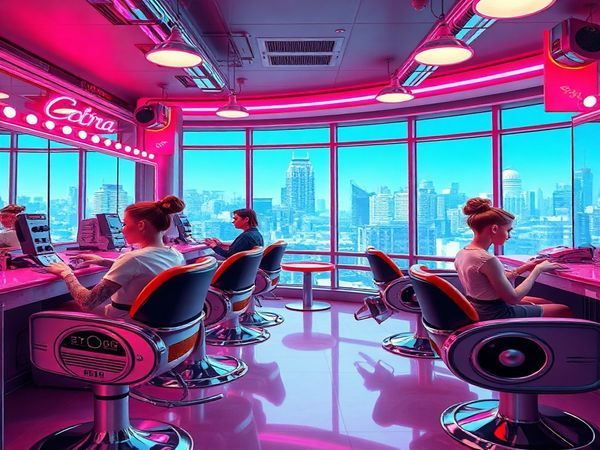
In the 1950s, the future was a place of bright, sleek surfaces and seamless living. This vision extended to all facets of life, haircutting included, fueled largely by an enthusiastic embrace of modernity and new technologies. Futurists of the era, often peering through the lens of rapid advancements in science, foresaw a world where even barbershops would become high-tech sanctuaries. There were grand hopes of automated haircutting machines – contraptions where a customer could sit, press a button, and emerge minutes later perfectly coiffed. The optimism of the time painted a picture where cumbersome tasks like haircutting were effortlessly streamlined by robotics.
Science fiction, always a fertile ground for futuristic musings, captured this zeitgeist. Films and comic books depicted salons filled with robotic arms deftly snipping locks with laser precision. These narratives often showed futuristic cities where the mundane had been transformed into the magical, and a haircut meant stepping into a pod, emerging with a brand-new style almost instantaneously.
At the societal level, these dreams reflected a confidence in human ingenuity and an unshakable belief in the boundless potential of technology. In living rooms and barbershops alike, conversations crackled with excitement about the possibilities of tomorrow. Technological exposés and magazines were awash with illustrations of what this automated era might bring. The professional dialogue in cosmetology hovered around the integration of emerging technologies with age-old techniques. Experts discussed new tools like electric razors, hinting at more dramatic changes on the horizon.
Yet, this grand optimism wasn’t devoid of human touch. Hair, after all, is a personal statement and a mark of identity. People speculated that technology would bring not just efficiency but also a newfound freedom in personal expression. The personal was meeting the mechanical, and many expected future haircuts to reflect individual styles created by personalized machines, thereby making everyone unique yet universally stylish.
The Twists of Reality: Haircuts Then and Now
Fast forward to today, and the evolution of haircuts offers a story both familiar and surprising. While haircuts have certainly seen innovation, the sweeping transformations predicted in the 1950s largely stayed tethered to the imagination. Robotics never quite replaced the nuanced art of haircutting, where human touch provides comfort and customization that machines struggle to replicate.
In industrial design and technology, small yet significant tools – like the electric trimmer – have carved a niche in barbershops and salons worldwide, echoing the predictions of grooming efficiency. However, the elaborate machines imagined in the mid-century remained largely conceptual, hindered perhaps by the complexity of human hair and style preferences that aren’t easily reduced to algorithmic solutions.
Instead, the digital age brought a different kind of technological infusion. Today, customization is largely driven by software rather than hardware, with augmented reality apps that allow clients to visualize styles before scissors ever touch a strand. Social media platforms now influence hair trends more than any automated tool imagined in the 1950s, bridging communities in ways those futurists never envisaged.
Interestingly, where the 1950s saw a future of uniform precision, today’s trend champions diversity and individualism. We see hairstyles shaped more by artistic creativity than by precise mechanical efficiency. The core prediction that remained true is the unyielding pursuit of individuality and self-expression, although the methods and mediums have shifted from machines to digital interfaces.
Lessons in Future Gazing: Haircuts and Human Nature
Reflecting on the gap between the mid-century imaginings and modern reality, there’s much to learn about how humans envision the future. Firstly, the 1950s’ predictions highlight a tendency to extrapolate the present into the future. The era’s faith in machinery and automation colored their vision of tomorrow, hinting that often, our future gaze is more a mirror of our current context than an unveiling of the actual future.
The story of haircuts reveals a broader truth too: technology frequently augments rather than replaces human skills, especially in areas involving personal touch and creativity. The continuing importance of human stylists points to a balance that technology and artistry must strike. It emphasizes that while machines can replicate efficiency, they struggle with empathy and intuition, human qualities vital in personal services.
Furthermore, the journey of haircuts underscores the unpredictability of cultural shifts. Who would have anticipated that social media and digital platforms would drive hairstyling trends? This unexpected path signifies that technological improvement isn’t solely about mechanical innovation but often broader, culturally driven processes that shape society.
Ultimately, the exploration of 1950s predictions versus today’s reality around something as universal as a haircut offers a slice of how humans construct futures from their imaginative cores. It presents a narrative where the mechanics of invention meet the art of human expression, weaving a tapestry that’s richer precisely because of its unpredictability.
In contemplating the future, and as witnessed with haircuts, our most accurate guide may be an enduring curiosity paired with the flexibility to welcome the unforeseen, rather than tightly held images of what must come next.