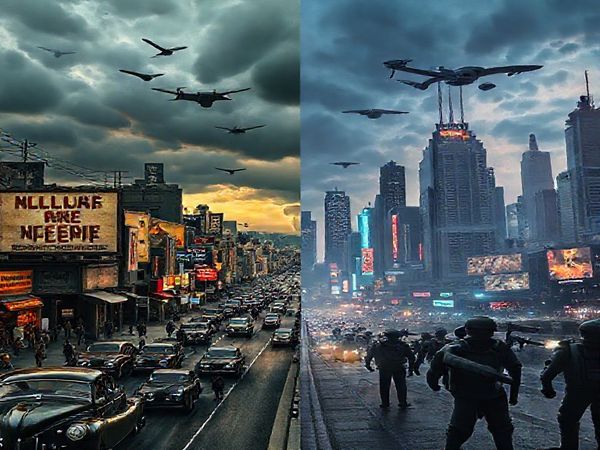
Clashing Visions: 1940s Predictions of Future Violence vs. Today’s Reality
The 1940s was a decade immersed in the aftermath of World War II and the incipient steps of the Cold War. It was a time of deep reflection and anxiety about the future of humanity and the potential for violence to redefine societies around the globe. The era was shaped by the immense destruction of the war, the looming threat of nuclear weapons, and the ideological tensions that would ripen into the Cold War. As people grappled with the trauma of the past, they also worried about what lay ahead. Predictions and fantasies about future violence were not just bleak projections; they were coping mechanisms, mirrors reflecting the shadows of uncertainty that spanned the globe.
Imagining the Future of Violence in the 1940s
In the turbulent landscape of the 1940s, predicting the future of violence took on various forms. On one hand, those in academic and policy-making circles envisioned a world where humanity learned from past conflicts to create international systems to maintain peace. The United Nations was established in 1945, embodying the hope that diplomatic dialogue could prevent future warfare. Yet, optimism was often tempered by reality. Many feared that the atomic bomb, whose devastation had been freshly witnessed in Hiroshima and Nagasaki, would fundamentally change the rules of engagement. The bomb was not simply a more powerful weapon; it was an existential threat that could spell the end of civilization.
Popular media of the era often oscillated between these visions of hope and dread. Science fiction began to explore futures where humanity either thrived or destroyed itself with technology. Films like “Things to Come” (1936) may have been slightly earlier, but they encapsulated a future where war was an inevitable force that propelled human progress and regression alike. As the 1940s closed, literature and films began using burgeoning atomic anxieties to fuel narratives that hovered between utopian possibilities and dystopian nightmares.
In everyday conversations, people were both hopeful and fearful. Veterans returning from the war often struggled with the demons of combat, yet they were also community leaders in rebuilding efforts. The contrast between past horrors and current prospects shaped discussions about future conflicts. AI-based, robotic futures were imagined, where violence became more strategic and less personal. The possibility of wars fought by machines was a theme that began to captivate the public psyche.
Professionally, military strategists and policymakers debated the role of conventional warfare versus nuclear deterrence. With major powers developing atomic capabilities, a strategic balance of terror began to take form in discussions. Diplomats were negotiating treaties with the hope of containing the spread of nuclear arms. The future of violence was envisaged as less about mass armies clashing and more about political chess games where nuclear-armed nations held all the pieces.
Reality of Violence Over the Years
As the decades rolled by, the future revealed its unpredictable tapestry. The Cold War era saw no global conflict of the magnitude foreseen in the 1940s. However, it was peppered with regional conflicts and proxy wars, often marked by a mix of conventional and guerilla warfare. The Korean and Vietnam wars, as well as numerous Middle Eastern conflicts, highlighted a departure from the predicted dystopian nuclear showdowns.
Nuclear deterrence did indeed take center stage, but its role was different from the total annihilation many had feared. Instead of obliteration, the presence of nuclear weapons created a fragile peace, one that rested on mutual destruction which inhibited direct confrontation between nuclear powers. Arms control treaties and diplomatic negotiations became pillars of stability.
Terrorism emerged as a form of asymmetric warfare that was less anticipated. While some predicted non-state actors might become relevant, the focus of the 1940s was largely on national conflicts. By the late 20th and early 21st centuries, terrorism influenced global security in profound ways, reshaping cityscapes with surveillance and changing societal norms towards safety and freedom.
The rise of technology did herald the dawn of cyber warfare, a novel realm not widely predicted in the 1940s. Nations now engage in battles over networks and information rather than territory, a shift that has created both vulnerabilities and new strategies. Automation and drones also introduced new dimensions to the military landscape, making the specter of robotic warfare a partial reality.
Although some aspects of soldiers on battlegrounds remained prevalent, the face of warfare changed with technology and political transformations. The significant gap between expected nuclear apocalypse and the reality of contained yet ongoing conflict highlights both underestimations and overestimations of the era’s futurists.
Lessons From Past Predictions
Today’s examination of the discrepancies between past predictions and evolving realities offers several insights into human nature and societal development. One recurring theme is that human projections of the future often mirror their current fears and aspirations rather than accurate forecasts. The intense focus on nuclear capabilities and large-scale warfare in the 1940s was a reflection of the contemporary geopolitical landscape and psychological aftermath of the World War.
Another lesson is the remarkable adaptability of societies in the face of dystopian predictions. Despite the constant threat of annihilation, negotiation and diplomacy often prevailed, suggesting a resilient and hopeful aspect of human nature that persists through crises.
Moreover, the ongoing evolution of violence, encompassing terrorism and cyber warfare, reveals a persistent adaptability of conflict itself. While the tools and tactics shift, the fundamental drivers – competition, resources, ideologies – remain the same. It reminds us that while technology advances, human tendencies do not alter as swiftly.
Reflections on past visions of violence also offer a caution about underestimating novel threats. As current prospects revolve around climate change, artificial intelligence, and biotechnological advances, examining past misconceptions may better equip us to identify and preemptively address emerging threats before they crystallize into reality.
In conclusion, while the future remains as unpredictable as ever, understanding our past imaginings of it sheds light on our current trajectories and the enduring human experience of navigating uncertain waters. It is a blend of hope, fear, innovation, and resilience that continues to write the script of our shared future.