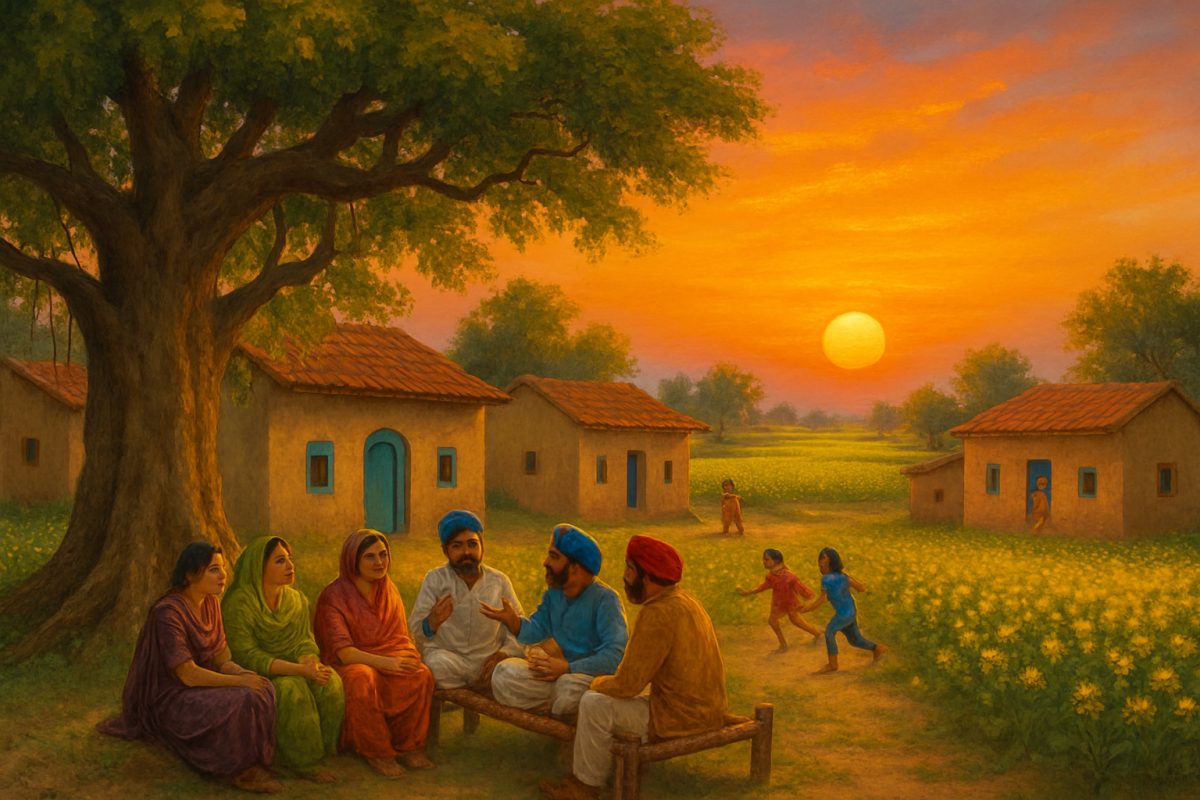
Exploring Human Rights in Rural Punjab: New Study Sheds Light on Challenges and Progress
The Quest to Unearth Realities
In the landscape of bustling research endeavors, how does one decide to zoom into the microcosm of a Punjabi village? For a group of avid researchers led by Pathak et al., the journey set out not just from academic curiosity, but from a lived understanding of the pulses that beat within India’s rural heart. In their exploration, these researchers aimed to unravel the oft-unseen tapestry woven of everyday struggles, triumphs, and the aspiration for dignity in rural Punjab. The desire to look beyond surface statistics into the realities of human rights at the ground level guiding their inquiry.
The researchers were spurred by a quest to find out more about how India, as the world’s largest democracy, manages its obligations under international human rights laws, especially in rural settings where the majority of the population resides. This study attempted to answer whether fundamental human rights related to health, education, and political participation were being respected, protected, and fulfilled as promised by the local panchayati raj institutions.
Tales from the Field: Capturing Voices
To tread the path less traveled, the team opted for a hands-on engagement with those who live the experiences under study. With a robust quantitative approach, they crafted survey questionnaires directed at both the hymn of the elected Gram Panchayat members and the often-voiceless citizens benefiting from government schemes. By creating pathways to dialogue, the researchers sought to measure the pulse of human rights enforcement where it truly counts – amidst the lives in villages.
The data painted a picture richer and more nuanced than any hardline claim. Here emerged stories of inconsistency, where the official declarations of the panchayat members sometimes drifted away from the practical experiences shared by the beneficiaries. This discord mirrored the larger deficiencies in infrastructure and service delivery, shedding light on how these essential rights sometimes slip through the fingers of the intended recipients.
The Ripple Effects of Unmet Promises
As I pore over the findings, my reflections turn to the broader implications these revelations suggest. Health, education, and political participation represent cornerstones of a robust society. Deficiencies noted, such as in the National Rural Health Mission or the Samagra Shiksha Abhiyan, do not just spell developmental delays but can cascade into affecting the very fabric of villages.
While there are recommendations for awareness campaigns and active participation initiatives, as an experienced science journalist, I perceive the need for a deeper cultural shift. Electoral participation should be more than attending meetings. It should be about fostering genuine involvement that empowers, especially for marginalized sections. The future lies in transforming these platforms into stages where voices, otherwise stifled, can echo with potential change.
Connective Threads in a Global Tapestry
Sampling the rhythms of rural Punjab taps into a universal narrative playing out globally. Whether in the remote villages of India, or in different corners across the world, the thirst for human rights transcends borders. In this connected global society, the challenges faced in India find resonance in other parts too, locking contexts in a potent blend of similarity and divergence.
Striving to promote awareness and enforce rights in rural Punjab aligns with the broader trend towards enhanced global human rights recognition. The study does not only serve as a beacon for focused knowledge but also emerges as a junctional example of how microcosmic changes can impact international dialogues. It reminds us of a constantly evolving dance between promises made and promises kept, a narrative not unique to Punjab but echoed across continents. It reaffirms that the grand arc of human rights progress is bent with the endeavors that happen in villages akin to stepped stones.
Rethinking the Path Forward
What does this path-breaking study suggest for us, as stakeholders of global consciousness? By engaging with micro-communities within larger systems, we begin to engage with conversations missing from grand international discussions. It is a call to care, to turn policy promise into small specific actions that ripple outwards. Bearing witness to such research can inspire policy-makers, social actors, and individuals alike to reflect on how a village’s realization of human rights pulls us all forward.
In the words of those who stood on the frontlines in researching the enforcement of human rights within Punjab’s Gram Panchayats, the core lies in turning aspirations into tangible realities. With this study, a spotlight shines on conversations that matter, asking not only what is but what could be. And in those words, perhaps, lies the potential for the dance of human rights fulfillment to find its finest rhythm yet.
Reference
Pathak, P., Nandini, V., Yadav, D., Kaur, S., Sen, R. K., & Riang, S. (2025). Realizing Human Rights in Rural Punjab of India: A Study of Selected Human Rights Enforcement. Frontiers in Sociology, 10, 1619603.