From Flappers to Futurists: The 1920s Vision for Student Life Meets Modern Reality
In the shimmering glow of the 1920s, a decade alive with jazz tunes, flapper fashion, and a burgeoning sense of modernity, the future stretched out like a vast and inviting tapestry. The era was a cradle of creativity and innovation, a time when people dared to dream of soaring skyscrapers and flying cars. Among these visions of tomorrow were imaginations of student life, which were fueled by the cultural, social, and technological evolutions of the decade. How people in this vibrant period envisaged the students of the future was as telling about the age they lived in as it was about the ages to come.
Visions of Learning in the Roaring Twenties
In the 1920s, as the world teetered between the shadows of the First World War and the promise of a dazzling new era, imagining the future was a mix of hope and nostalgia. People were enthralled by the rapid pace of technological advancements. The radio was transforming communication, roads were teeming with automobiles, and movies – with their black-and-white images flickering against the silver screens – were becoming an essential cultural force. These technologies inspired visions of a future where student life was reshaped by innovations.
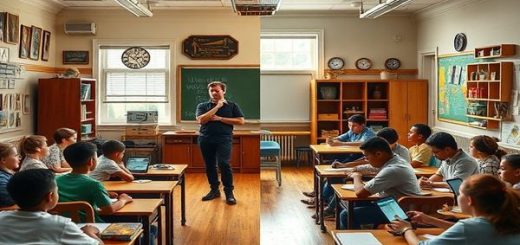
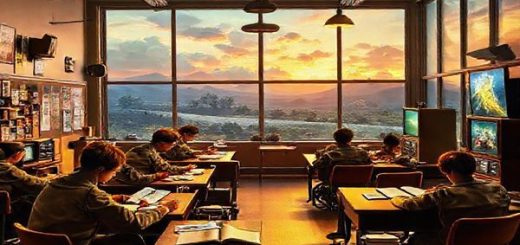
Futurists of the 1920s painted a picture of education that was intertwined with technological marvels. They imagined classrooms equipped with air-conditioning, where pneumatic tubes delivered lessons, and where voice-recording machines would allow students to listen to their teachers’ voices on demand. In a forward-looking article of the time, it was suggested that future students might learn through “moving-picture textbooks”, predicting a form of visual learning assisted by films – an idea that eerily presages the role of educational videos and documentaries today.
Popular media of the era further cemented these expectations. Science fiction, still in its infancy, offered glimpses of academic life freed from rigid physical classrooms. Authors and filmmakers envisioned a world where personal aircraft whisked students away to exotic locations for firsthand learning experiences. The imagination ran so wild that what was then considered implausible seemed perfectly achievable in the minds of the public.
Ordinary people, debating these future prospects in everyday settings, often mixed skepticism with fascination. In the 1920s, many still saw education as a privilege rather than a universally accessible right, and there were ongoing discussions about how technology could democratize learning across different socio-economic backgrounds. These sentiments resonated in professional circles too, where educators advocated for the price of progress being a freer, more egalitarian spread of knowledge.
Amidst these technological dreams, though, lay a deeper emotional longing. The 1920s was a time of reaching out from the depths of post-war society toward a more hopeful horizon. This was reflected in the way people yearned for a future where education was not only about the transfer of knowledge but also about cultural enrichment and personal growth. The student life of tomorrow was seen as one of exploration and creativity, not held back by geographical or even societal constraints.
How Student Life Evolved – A Look at Reality
Fast forward to reality, the student life as we know it today is a mosaic of both anticipation and surprise. It has indeed seen advances that would have thrilled the imaginative minds of the 1920s. Classrooms filled with interactive whiteboards, virtual classrooms that bridge oceans and continents, and visual aids like YouTube lectures and digital textbooks have all materialized, echoing those early predictions of technology’s role in education.
Yet, some facets have evolved differently than expected. Instead of air mail tubes, we have the internet – a network unimaginable in the 1920s yet so significantly influential that it surpasses any futuristic postal system they could dream of. The notion of learning through direct experiences in far-flung locales is now mirrored in study abroad programs and immersive virtual reality environments that transport students to ancient Rome or the Great Barrier Reef without stepping outside a building.
Surprisingly, one of the most significant changes in student life came in the form of accessibility and diversity of educational opportunities, often overshadowing technological advancements. The post-war world saw education increasingly viewed as a right rather than a privilege, leading to mass education movements and later, the internet becoming a great leveler by offering free resources like online courses to anyone with access.
While the 1920s imagined glamorous visions of technology bringing education to students in sleek, stylish packages, the reality became one of functional yet profound advancements. It wasn’t only about gadgets and gizmos; it was about the transformative power of knowledge and how it could be disseminated widely and equitably. A student in today’s world accesses an education enriched by cultural exchange, intertwined with global narratives, unlike any envisioned in the silence of those early 1920s films.
Lessons from the Past, Insights into Humanity
Reflecting on the diverging paths between 1920s predictions and today’s reality reveals much about human vision, aspirations, and the nature of educational progress. It underscores a truth universally acknowledged – we often conceive futures with the lenses of our present, translating dreams into the tangible tools and technologies of our current moment.
The predictions crafted by the optimistic minds of the 1920s underscore a dual desire: the wish to wield technology to enhance learning, and the pursuit of knowledge as a universal right. They speak to the enduring human yearning to break barriers – be they geographical, linguistic, or social. This aligns with today’s reality, where the democratization of information is not just a concept but a lived experience.
These narratives remind us that education is not merely about information transfer but also about fostering the ability to think critically, to feel empathy, and to imagine boldly. The dreams of the 1920s echo into our present, reminding us to continually strive for an educational system that champions not only innovation but also inclusion.
Ultimately, the explorations of the future tell us perhaps as much about the visionaries themselves as they do about the eras they imagined. From the 1920s to today, and looking into tomorrow, one truth remains constant: every generation stands on the shoulders of its predecessors, poised to dream yet another future into being.