Unpacking Systemic Nostalgia: a feminist review of The Holdovers (2023)
Reconstructing the Past: Aesthetic Choices in ‘The Holdovers’
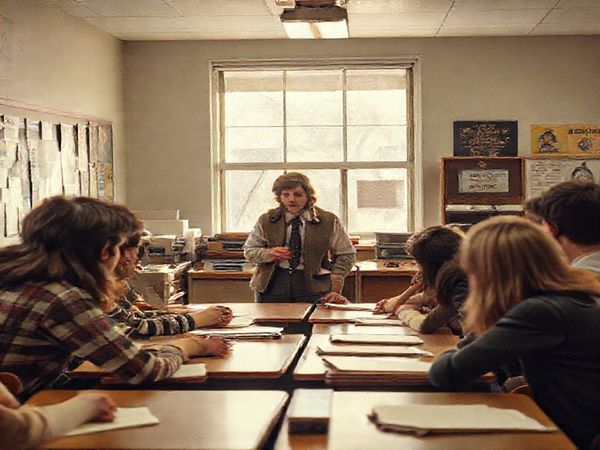
Alexander Payne’s film, The Holdovers (2023), channels a distinct 1970s aesthetic – from its melancholic cinematography to the leisurely unraveling of its narrative. The film revels in its era-specific authenticity, providing a visual feast reminiscent of cinema’s golden age while unfurling the poignant tale of a group of individuals seemingly trapped by both time and circumstance. Payne’s craft is evident in every frame, with careful attention to detail that evokes nostalgia without ever suffocating under its weight. Yet, beneath the visual charm, the film’s thematic exploration of nostalgia reveals more about the structures it seeks to romanticize, inviting an introspective look at the dynamics of gender and power at play.
Communication Across Barriers: Gendered Interaction
Communication in The Holdovers acts as a window into the gendered corridors of power and societal expectation. The film centers around Mr. Harrington (Paul Giamatti), a gruff and curmudgeonly teacher, and Mary O’Hara (Da’Vine Joy Randolph), a resilient yet underappreciated mother figure. Their interactions often orbit around the echoing halls of academic authority and domestic servitude, reflecting their entrenched roles within both the school and broader society. Harrington’s facade of authority is frequently challenged by Mary’s pragmatic wisdom, which quietly yet firmly asserts her agency. It is in these exchanges that we see the subtle rebellion against a patriarchal narrative that has traditionally sidelined the voices of women of color.
While conversations between the male students and Mr. Harrington often revolve around ambition and masculine bravado, the dialogues involving Mary dip into themes of empathy and resilience. However, the film’s narrative sometimes struggles to grant Mary as much agency as it bestows on its male protagonist. Her story is poignant and richly textured, and yet, too often, she is relegated to the role of an emotional catalyst rather than a driving force within her story arc.
Unveiling Gender Roles: Challenging Stereotypes
The film navigates familial and social expectations with a close eye on gender dynamics. Motherhood and caretaking are examined with a critical lens, challenging stereotypical narratives while revealing systemic biases. Mary’s role as a caretaker is both an empowering force and a limitation, highlighting how women’s labor, especially that of Black women, is undervalued. Her relationships with the students, particularly her soft mentorship peppered with tough love, defy traditional portrayals of female nurturing by embodying strength and vulnerability. However, Mary’s narrative occasionally flirts with the trope of the ‘strong Black woman,’ who shoulders burdens with grace but is not afforded the narrative space to explore personal ambitions beyond her role as nurturer.
In contrast, The Holdovers praises ambition through a distinctly masculine lens. Academic and personal ambitions of the male characters drive much of the plot, positioning them as active agents in narratives of self-discovery and transformation. This imbalance invites audiences to question how the script itself perpetuates gendered values, presenting male-driven ambition as aspirational while women’s ambitions remain secondary and underdeveloped.
Sound and Silence: Emotional Arcs and Agency
Payne’s use of sound and silence intricately weaves the emotional tapestry of the film, adding depth and texture to the characters’ emotional journeys. The soundtrack echoes the era’s nostalgic music, providing a backdrop for scenes that swell with unspoken emotion and latent tension. Silence, too, is ingeniously employed, allowing moments of introspection and unsaid thoughts to hang in the air – acts of quiet rebellion that speak volumes within a constrained narrative framework.
Mary’s moments of silence are particularly compelling, often inviting the audience to read between the lines and empathize with her unseen struggles. Nevertheless, these silences underscore a structural limitation within the narrative itself – those moments where Mary’s voice is not given the stage it deserves, and the complexities of her character are left implied rather than fully explored. In this way, the film opens a dialogue about whose stories are centered, urging viewers to acknowledge the beauty and richness of the stories untold.
Reflective Narratives: Enduring Values and Final Impressions
Ultimately, The Holdovers offers a visually stunning and introspective narrative, enriched by its exploration of human connection set against the backdrop of nostalgia. Yet, as audiences navigate the film’s charming aesthetic and poignant performances, they are also prompted to consider the underlying gender dynamics and value systems it perpetuates. Mary embodies a quietly defiant yet nurturing presence, offering a glimpse of empowerment within a narrative that occasionally skirts the boundaries of stereotype.
As the credits roll, viewers are left to ponder the film’s message about ambition, intimacy, and societal expectation. It is a reminder that while nostalgia can be a powerful narrative tool, it also risks glossing over the complexities and injustices embedded within the past. The beauty of cinema lies not only in its ability to transport us but in its power to reflect, challenge, and ultimately transform the world as we understand it. The Holdovers achieves both, offering an engaging yet layered cinematic experience.