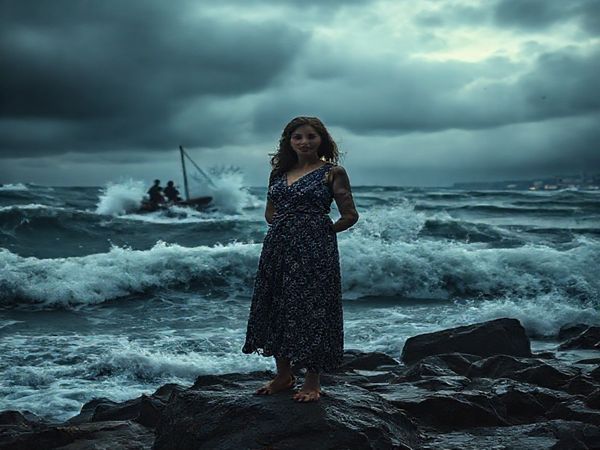
Breaking the Waves: a feminist review of Finestkind (2023)
Breaking the Waves: A Feminist Review of Finestkind
An Ode to Maritime Menace
There’s a haunting beauty in Brian Helgeland’s Finestkind that parallels the tempestuous sea itself, where light and dark mingle to create a stormy cinematic landscape. The film offers an intimate portrayal of a Brooklyn-born mother’s desperate gambit and her two sons’ bid to extricate themselves from an economic whirlpool deeper and more dangerous than any ocean treacheries they face. Helgeland masterfully blends tension with tenderness, using the gritty Massachusetts ports and the unforgiving Atlantic as both a backdrop and a metaphor for the churning undercurrents of his characters’ choices and family ties.
Equally captivating is the film’s visual composition. The cinematography vividly captures the contrast between the stifling interiors – revealing the constraints of the characters’ lives – and the vastness of the sea that appears to promise escape and freedom. Yet, despite Helgeland’s fluid directorial eye and the film’s stunning atmospheric allure, Finestkind is caught in familiar patriarchal nets, reflecting society’s gender biases in subtle but persisting ways.
Women As Anchors, Not Forces
The film revolves around Tom and Charlie, two half-brothers thrust into a dangerous fishing venture that spirals into a criminal entanglement. In stark narrative contrast, Helen, their mother, is as steady as an anchor, grounding the emotional stakes with a presence that, while warm and stable, is confined to the traditional maternal role. She exudes strength but lacks narrative agency, her character growth overshadowed by the men’s tumultuous journeys.
Moreover, Jesse, the film’s principal female counter-voice and Tom’s love interest, oscillates between seductress and savior. Her interactions with the male leads often gravitate toward emotional scaffolding rather than independent plot propulsion. Conversations between the women are sparingly placed, with the Bechdel Test passing by only a marginal thread. While they exchange words without male mediation, their discussions frequently circle back to concerns of the male domain, orbiting around the gravitational pull of masculine conflict.
Yet, in the quiet spaces between action, there’s a whisper of a different narrative yearning to be heard – a subtle resistance to gendered storytelling. Helen’s and Jesse’s subdued defiance, hidden in plain sight, highlights the untapped depths of their characters, suggesting a richer exploration that could have dived deeper into the complexities of family loyalty and personal ambition.
Familial Bonds and Gendered Expectations
One of the film’s central themes is the immutable nature of family ties – a theme explored here with poignancy and grit. Yet, Finestkind inadvertently overlays this narrative with persistent archetypes of masculinity, where risk-taking and stoic endurance equate to honor and strength. The film enshrines these attributes in its male characters, while the female roles become emotional stewards, upholding the family unit amid strife but never steering the ship.
What emerges is a layered depiction of family – an exploration of filial responsibilities entwined with reluctant compromises, yet entangled in gender-specific expectations. The film flirts with challenging these norms, most notably through Jesse’s self-sufficient persona, but ultimately retreats to safer harbors, reinforcing rather than dismantling the conventional gender dichotomies.
Navigating Artistic Integrity and Feminist Critique
While Finestkind may not fully cross into feminist territory, it is an emotionally resonant work that commands respect for its craft and narrative intensity. The dialogue, sharp and unvarnished, echoes the rugged environment it emerges from, although it may occasionally anchor itself too deeply in gendered benchmarks. Helgeland skillfully elicits solid performances from his cast, particularly in his ability to draw out complex emotional valences in seemingly bare settings.
Yet, for all its allure, the picture invites reflection on the enduring omnipresence of patriarchal storytelling. The sea is vast and untamed, but women’s arcs in Finestkind remain moored close to familiar shores, sidelined in passive roles that inhibit true narrative emancipation. The film’s subtle reinforcement of gender norms signifies cinema’s struggle to consistently merge aesthetic mastery with progressive cultural critique.
Ultimately, Finestkind finds beauty both in the turbulence and the calm, successfully navigating the realm of thrilling drama but falling short of charting a course where female characters are as richly developed and dynamically central as their male counterparts. Though it provokes admiration for its visual and emotional acuity, it challenges audiences to question and demand how films can subvert traditional dynamics and elevate women not merely as stabilizers but as equal tides, capable of shaping the narrative oceans they dwell within.