Subversive Allure: a feminist review of Don’t Worry Darling (2022)
A Visual Feast of Oppression and Desire
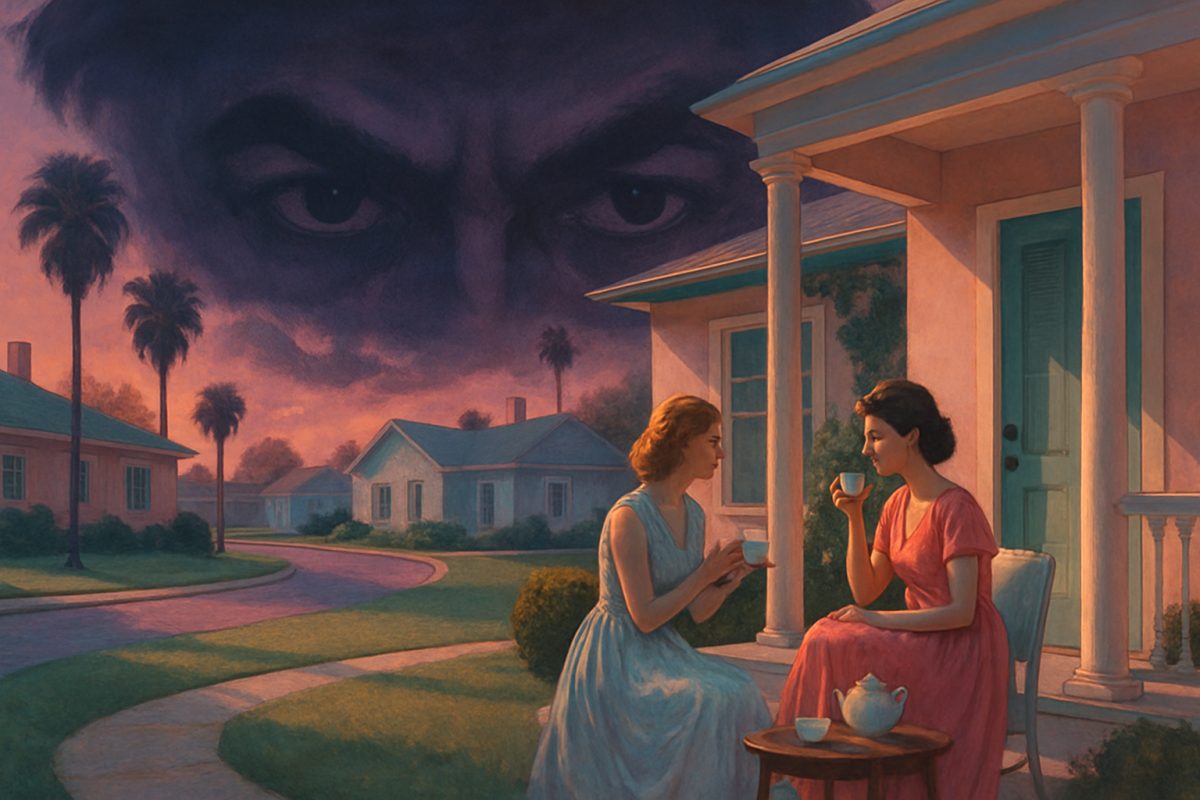
“Don’t Worry Darling” is undeniably a visual triumph, a film that bathes in the golden hues of its 1950s pastel dreamscape while simultaneously weaponizing its beauty to tell a story of control and confinement. Olivia Wilde’s directorial eye captures a world that is both seductive and suffocating, inviting the audience to marvel at the immaculate aesthetics even as they become implicit in the pervasive tension permeating each perfectly manicured lawn and meticulously styled frock.
The cinematography, rich in its palette and deliberate in its framing, weaves a narrative of its own – one of illusion versus reality, highlighting how a visually captivating exterior often conceals a more sinister infrastructure. In the same breath, Wilde’s camera doesn’t shy away from softening the lens on intimate moments of desire, where longing is palpable yet shadowed by an omnipresent sense of apprehension. It’s this duality that makes “Don’t Worry Darling” stand out as a film that both embraces and critiques its stylistic choices within the context of its thematic undertones.
Dissecting Gendered Silence and Speech
A feminist critique cannot overlook the film’s exploration of conversations – both those spoken and those silenced. While women’s voices often rise to prominence in Wilde’s sun-soaked dystopia, these voices also reveal the gendered delineations of power that underpin the narrative. The film places female dialogue at the forefront, yet the exchanges between women frequently occur under the vigilant eyes of male authority, reflecting the broader societal mechanisms that govern women’s speech.
Crucially, when women converse in “Don’t Worry Darling”, it’s not merely an appendage to the men’s storyline. There’s a palpable sense of subversive strength each time the women attempt to carve out pockets of autonomy, whether through hushed conversations over tea or shared glances that echo defiance. However, the screenplay sometimes falters—what could be an unyielding critique often veers into predictable tropes, hinting at revolutionary ideals without fully realizing them.
Gender Roles: Reinforcement or Revolution?
The film is steeped deeply in its 1950s setting, a milieu that allows it to scrutinize societal norms about gender roles — both reinforcing and subtly challenging traditional expectations. The dichotomy between surface-level perfection and underlying dissonance deftly captures the tension women navigate when striving for personal desire against oppressive conformity.
At its core, “Don’t Worry Darling” appears to engage with the institution of family, examining how women’s ambitions are thwarted within patriarchal frameworks. Through the protagonist’s journey, Wilde questions the gendered limitations of ambition and nurtures a narrative where intimacy becomes both a site of rebellion and a battlefield for dominance. It’s a complex dance, where the familiar tropes of homemakers and breadwinners are presented not simply as roles to play, but as battlegrounds for identity and self-actualization.
Agency in the Narrative: A Feminist’s Hope
Perhaps the most arresting aspect of Wilde’s narrative is its interrogation of agency. Women in “Don’t Worry Darling” are not monoliths; they are as varied in their desires as they are in their methods of seeking freedom. Unlike many films that reduce women’s roles to peripheral mementos, Wilde offers a script that allows her female leads to drive the plot in meaningful, if at times frustrating, ways.
The tension between coercive structures and personal determination is omnipresent, artfully conveyed through sequences where the protagonist pushes against the boundaries of her reality and her own understanding. This isn’t a tale of passive heroines waiting for salvation; it’s a chaotic, messy struggle punctuated by moments that resonate far beyond the screen. Yet, Wilde’s ambition also exacerbates the film’s inconsistencies — in its eagerness to prioritize the female experience, it occasionally overlooks nuances that could transcend the narrative’s limitations.
Closing Thoughts: A Cinematic Balancing Act
“Don’t Worry Darling” operates on a delicate balance, embracing its role as both an ode to the halcyon allure of the 1950s and a critique of its underlying patriarchal ethos. Wilde’s cinematic artistry coexists with her directorial critique, creating a film that is as captivating in its execution as it is provocative in its message.
In navigating these dualities, “Don’t Worry Darling” invites its audience to immerse themselves in a beautiful lie, all while prompting them to question the very nature of the façades modern society still maintains. It’s a work that dazzles, then disrupts, leaving the viewer to ponder not only the story on the screen but their own narratives of freedom, identity, and the pressures laid upon them by gendered expectations. It may not provide all the answers, but it certainly inspires deeper questioning, making it a worthy addition to the feminist film canon.