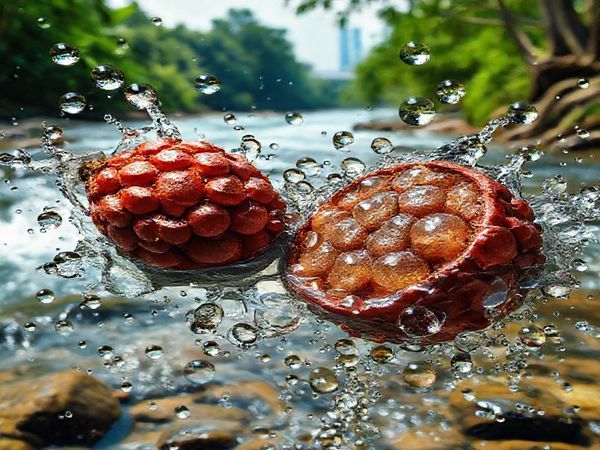
Tamarind Seeds Transform Into Powerful Purifiers for Nickel-Contaminated Water
Seeds of Change: Tamarind’s Unlikely Journey to Purification
In a world increasingly conscious of sustainability, innovations can often come from the most unexpected places. Enter the tamarind seed, a byproduct that has typically seen the less glamorous side of culinary notoriety. Today, researchers are turning these humble seeds into powerful tools for water purification. This narrative weave isn’t just about unlocking potential in waste; it’s a testament to how curiosity and resourcefulness can tackle modern environmental challenges.
Beyond Surface Value: The Quest for Sustainable Solutions
The researchers set out with a curiosity-driven question: Could tamarind seeds, often discarded without a second thought, be transformed into a valuable resource for environmental remediation? This inquiry is driven by the ever-growing need to address pollutants like nickel in wastewater, which pose significant health risks. Nickel, even in small amounts, can lead to severe environmental and health impacts. Current methods of removal are effective, yet often unsustainable or costly.
What if waste could help manage waste? This was the intrigue for the team led by Janthabut and colleagues. By tapping into tamarind’s potential, they sought not only to alleviate the burden of water pollution but to address waste management issues simultaneously. The study was thus not just about purification, but also about reimagining the untapped value in what we consider refuse.
Crafting Carbon: A Tale of Two Methods
The study delved into the transformation of tamarind seeds into activated carbon, focusing on two distinct methods: traditional carbonization and an innovative hydrothermal approach. Their investigation revealed something fascinating; the hydrothermal method outshined the traditional one by creating activated carbon with a significantly higher surface area.
This technical leap is crucial. A larger surface area translates into a more effective adsorbent, meaning the tamarind-derived carbon can remove more nickel ions from water. Specifically, the carbon exhibited mesoporous and microporous structures, with a remarkable specific surface area of 1172 m²/g. Such structural features make it highly adept at capturing nickel ions, achieving nearly 100% removal in the study’s conditions. This demonstrates the hydrothermal method’s potential to revolutionize our approach not only to wastewater treatment but also to material utilization.
Implications Beyond the Lab: A Broader Vision
The potential applications of this technology extend far beyond the laboratory. Imagine communities with limited resources being able to leverage local organic waste products to clean their water sources effectively. This study points to a future where environmental sustainability is accessible and affordable to many.
As a journalist, I find it both humbling and exciting to witness the technologies that could redefine sustainability. The results of this research challenge us to rethink what qualifies as waste and how we might better harness natural materials. Furthermore, by improving the adsorption capacity and efficiency of such materials, we streamline processes and lower costs, enhancing accessibility.
Refining the Waste Narrative
There’s a broader narrative at play here that goes beyond science and technology; it’s about reframing our relationship with waste. The implications of this research reach into the realms of environmental ethics and policy. Embracing biomaterials like tamarind for industrial purposes could significantly reduce reliance on non-renewable raw materials. It embodies a shift towards circular economies – systems where nothing is wasted, and everything is reused for benefit.
Consider this: In the future, waste from your meal might not just go to the landfill. Instead, it could be reprocessed into vital components for water purification systems, thereby closing the loop from use to reuse. Each step forward in research like this doesn’t just solve an immediate problem; it redefines potential, urging further questions about what other organic materials hold untapped promises.
Ultimately, the process of turning tamarind seeds into advanced water purifiers is a vivid example of innovation’s power when braced with humility and insight. This study’s real triumph might just be in inspiring more investigative paths to convert the ‘discardable’ into the ‘irreplaceable’ in our pursuit of a healthier planet.
Janthabut, P., Athikaphan, P., Jekrukand, P., Kanjunsi, P., Kongkoed, P., Nijpanich, S., … & Neramittagapong, S. (2025). Adsorption of nickel (II) ions onto activated carbon from tamarind seeds for synthetic wastewater treatment: Isotherm, kinetic, and thermodynamic studies. Environmental Challenges, 101243.