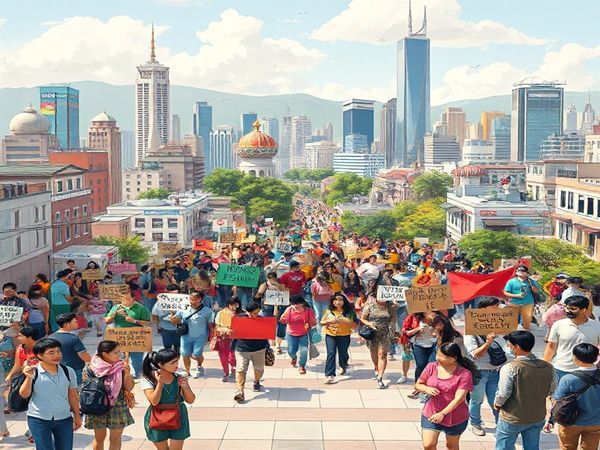
The Rise of Human Rights Cities: How Local Communities Are Leading Global Change
Cities as Global Human Rights Leaders
In a world grappling with unprecedented global challenges, from climate change to social inequality, the concept of cities championing human rights innovation might seem, at first glance, paradoxical. Yet, as Shaham-Maymon reveals in a groundbreaking study, cities are not just rising to these challenges; they are uniquely positioned to lead them. The study, published in Political Studies, explores how an increasing number of urban hubs are transforming into ‘human rights cities’, localized powerhouses fostering a global ethos of citizenship rooted in freedom, equality, and dignity.
The backdrop to this research is striking. As national governments often struggle or hesitate to implement comprehensive human rights policies, local governments have the agility and immediacy to address the needs of their communities. This raises a compelling question: How do cities, with their diverse populations and local peculiarities, internalize and manifest universal human rights principles?
A Quest to Define: Thin versus Thick Human Rights Cities
Amid this emerging trend, Shaham-Maymon’s curiosity was piqued by the broad application of the term ‘human rights city’. While many cities claim this title, what does it actually mean for them? This study takes on the challenge of exploring this very question by distinguishing between ‘thin’ and ‘thick’ human rights cities.
A thin human rights city may adopt a largely symbolic approach. Think declarations, events, and a general endorsement of human rights. While these gestures are important, they may not necessarily translate into deep systemic change. Conversely, a thick human rights city embodies human rights actively and comprehensively. Here, municipal laws, policies, and everyday practices reflect a deep-seated commitment to human rights principles.
The study does more than categorize. It also breaks new ground by introducing two nested sub-models within these categories, offering a nuanced understanding that can guide comparative analysis across different urban contexts.
Gwangju: A Case Study in Civic Transformation
Taking a closer look, the research shines a spotlight on the South Korean city of Gwangju. Famously resilient, Gwangju is recognized as a pioneering human rights city. Through a meticulous review of documents and interviews conducted with local stakeholders, Shaham-Maymon illustrates how Gwangju functions within this typology.
Gwangju’s particular mechanisms for engaging with human rights practices demonstrate a sophisticated blend of declarative and practical approaches. The city leverages its historical context and cultural ethos to manifest a robust model of a ‘thick’ human rights city. The roots of this practice are not merely in political declarations but in the living, breathing practices of city governance and community engagement.
Hyper-Local Meets Universal
One might wonder why Gwangju, or indeed any city, would bear the mantle of human rights when such endeavors historically belong to the nation-state. The study indirectly addresses this by highlighting a key aspect: hyper-local responses can often achieve what bureaucratically encumbered national efforts cannot. This gives rise to the notion of “city-zenship,” an idea that may reshape how citizenship and human rights are perceived and enacted in the 21st century.
Cities like Gwangju, with their immediate connection to the daily lives of individuals, have the potential to become sites of innovation and grassroots human rights practices. The implications of this are profound. As cities continue to pioneer unique local responses to global problems, they challenge traditional hierarchies of governance and foster a new civic identity rooted in shared human dignity.
A New Dawn for Civic Empowerment?
The rise of human rights cities raises intriguing possibilities for the future. Will more cities look inward to redefine outward ideals of justice and equity? How might this shape global human rights discourses, long dominated by state actors?
From a broader perspective, this study invites us to reflect on the shifting power dynamics in global governance. As cities step up, the traditional monopoly of nation-states might give way to a more pluralistic, city-driven model of human empowerment. Yet, it also brings new challenges and dilemmas, such as ensuring accountability and uniformity in the application of human rights across diverse contexts.
In synthesizing the insights from this research, it’s evident that the movement towards human rights cities is both an inspiring narrative and a call to action. The burgeoning realm of city-led human rights advocacy may indeed herald a new era of civic empowerment and global progression.
At a time when the world needs localized solutions to universal problems, we might find that our greatest allies aren’t faraway governments but the cities we call home.
Reference
Shaham-Maymon, G. (2025). Localizing human rights: Modeling human rights cities. Political Studies, 73(3), 1194-1213.