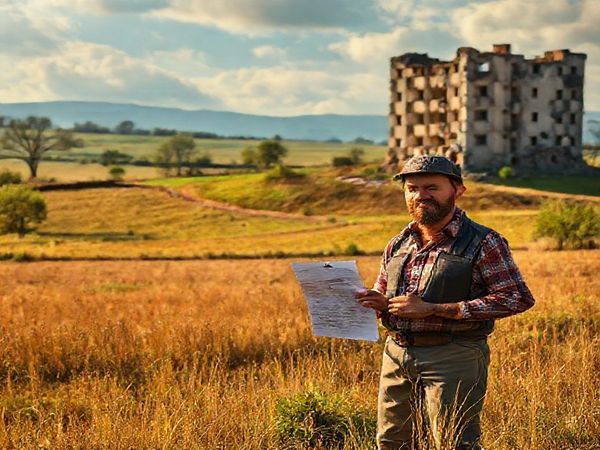
How Romania Navigated Property Restitution Challenges After Communism’s Fall: A Look at Legal Loopholes and ECHR Compliance
The Roots of Restitution Challenges
When the curtain fell on Romania’s communist regime, the country was left navigating the labyrinth of its past policies, particularly the legacy of property seizures. The allure of owning land is a deep-rooted part of human history, serving as a symbol of stability and personal legacy. However, for many Romanians, such aspirations were abruptly halted as the state appropriated private properties. With communism’s collapse, a pressing question arose: How should these wrongs be righted? The complexities of this quandary caught the attention of researcher M. C. Györgyjakab, who sought to dissect the numerous challenges bedeviling Romania’s restitution process.
The Elusive Dance of Legal Compliance
Györgyjakab’s research, aptly titled “Property Restitution in Romania: Administrative Challenges and Compliance with The Case Law of The European Court of Human Rights-Case Study,” delves into the intricate dance between national laws and international expectations. The European Court of Human Rights (ECHR), a guardian entity of individual rights across the continent, has frequently nudged Romania to honor its constitutional commitments. The crux of the issue lies not in Romania’s lack of laws guaranteeing restitution, but rather in their implementation. Bureaucratic bottlenecks and resource shortages have historically hampered progress. Despite repeated prodding, Romania’s adherence to these legal commitments is often spotlighted by the ECHR, revealing a gap between promise and practice.
Bureaucratic Labyrinths and Political Will
The nature of bureaucracies is to adhere to complex systems of rules which often create more red tape than clarity. This sentiment echoes in Romania’s experience post-communism. From 2009 to 2023, the restitution of properties was marred by obstacles at every corner. Györgyjakab’s study shed light on the widespread bureaucratic inertia preventing swift restitution, a problem exacerbated by a lack of decisive political action. For a genuine resolution, the study stresses, the surge of political will cannot be underestimated. The drag of administrative inaction continuously tests the patience of citizens awaiting justice for decades-old grievances.
The Court’s Watchful Eye
The ECHR has long been a symbol of accountability, persistently urging Romanian authorities to prioritize restitution. Its rulings and recommendations underscore the importance of respecting human rights as enshrined in legal frameworks. However, as the study underscores, there remains a disconnect between policy and execution. For genuinely meaningful progress, public administrations must not only embrace transparency, but also cultivate trust among citizens. Judicial independence is another critical dimension that does not escape the scope of this research. Independence assures citizens that legal outcomes are determined by law, free from undue external influences.
Reflecting on the Broader Picture
The tale of Romania’s restitution journey raises broader reflections beyond property and law. It highlights the intricate dynamics between state accountability, international obligations, and the individual’s quest for justice. In a society still healing from a heavy-handed regime, trust in public institutions becomes a cornerstone of rejuvenation. Understanding and addressing the constraints identified in Györgyjakab’s study can illuminate pathways not only navigating past struggles but building stronger civic bonds.
In reading Györgyjakab’s findings, one realizes the echoes of similar struggles resonating across societies confronted with reconciling past injustices. These challenges underline the importance of both political resolve and administrative efficiency in achieving meaningful restitution. They also invite us, as global observers and participants, to reflect on our own societal commitments to justice, revealing the constant evolution required to truly uphold human rights.
Reference:
Györgyjakab, M. C. (2025). Property Restitution in Romania: Administrative Challenges and Compliance with The Case Law of The European Court of Human Rights-Case Study. SEA-Practical Application of Science, 13(37), 31-37.